

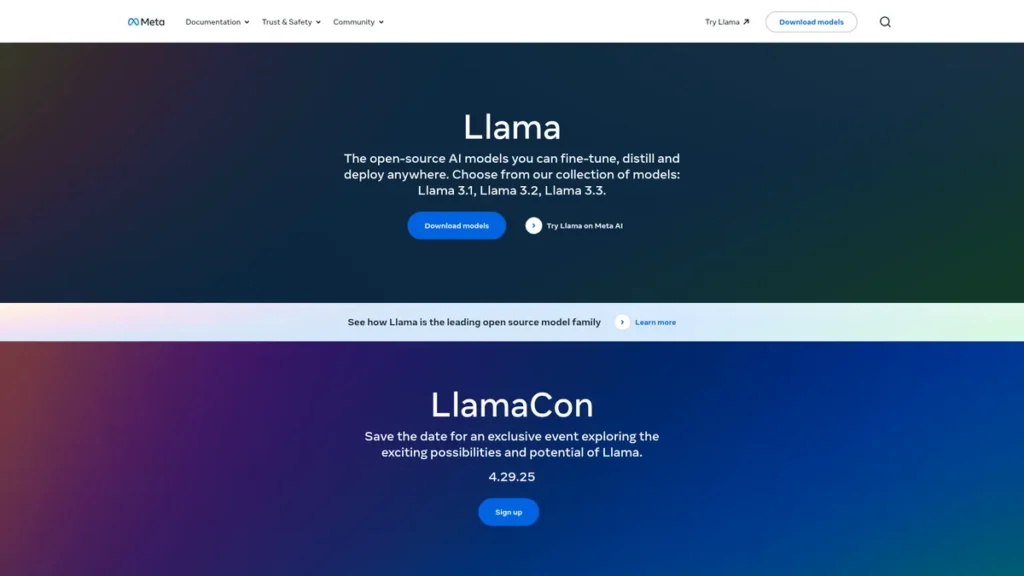
What is Llama?
Llama is a family of large language models (LLMs) developed by Meta AI. For a small business owner, it’s not a ready-to-use application like a word processor or CRM. Instead, think of it as a powerful engine. It’s a foundational technology that developers can use to build custom applications that understand, generate, and process human language. Businesses can leverage Llama to create their own AI-powered tools, from internal knowledge base search systems to sophisticated customer-facing chatbots. Its primary function is to provide the core intelligence for applications that need to work with text, offering a high degree of customization that off-the-shelf products often lack.
Key Features and How It Works
Llama operates by processing vast amounts of text data to learn patterns, grammar, and context. This allows it to perform complex language tasks. For a business, its value is realized through its core capabilities:
- Automated Text Generation: This is Llama’s most direct function. It can be used to draft marketing emails, create first drafts of blog posts, generate product descriptions, or even write code. The process involves giving the model a prompt, and it generates a coherent and contextually relevant text output. This can significantly reduce the time spent on content creation.
- Natural Language Understanding (NLU): Llama can interpret the intent and meaning behind user queries or feedback. A business could build a tool that automatically analyzes customer support tickets, routing them to the correct department based on the content of the message, without manual intervention.
- Sentiment Analysis: By analyzing text, Llama can determine the emotional tone—positive, negative, or neutral. This feature is invaluable for gauging customer satisfaction from reviews, social media mentions, or survey responses, providing actionable data without requiring hours of manual reading.
- Multilingual Support: The model is trained on data in multiple languages, enabling it to translate text or create content for global audiences. This allows a small business to expand its reach internationally without the high overhead of hiring translation services for every piece of communication.
Pros and Cons
Evaluating Llama requires a practical look at its benefits and drawbacks from a business operations perspective.
Pros
- Cost-Effective Foundation: As an open-access model, Llama has no direct licensing fees, which drastically lowers the entry cost for building custom AI solutions.
- High Degree of Customization: Unlike proprietary, closed-box AI services, Llama can be fine-tuned on your company’s specific data. This results in an AI tool that understands your unique industry jargon, brand voice, and customer base.
- Scalability: The architecture is designed to handle large volumes of data and requests. A tool built on Llama can grow with your business, from handling a few hundred customer queries a day to tens of thousands.
- Enhanced Productivity: Automating repetitive text-based tasks—from writing emails to summarizing reports—frees up employee time for higher-value strategic work, directly impacting the bottom line.
Cons
- Requires Technical Expertise: This is not a plug-and-play solution. You need access to developers or data scientists to implement, fine-tune, and maintain an application built with Llama.
- Potential for High Operational Costs: While the model is free, running it requires significant computational resources (cloud hosting, powerful GPUs), which can become a considerable operational expense.
- Integration Complexity: Integrating a Llama-based application into your existing tech stack (like a CRM or e-commerce platform) can be a complex and resource-intensive project.
Who Should Consider Llama?
Llama is not for every business. It is best suited for small to medium-sized businesses that have identified a specific, high-value use case for a custom text-based AI tool and have access to technical talent, either in-house or through a reliable contractor. Consider Llama if you are:
- A tech-forward company looking to build a proprietary AI feature that gives you a competitive edge.
- A marketing agency aiming to develop a custom content generation tool tailored to your clients’ specific brand voices.
- A business with a high volume of customer support inquiries seeking to build a more intelligent, context-aware chatbot than what standard services offer.
- An organization that needs to analyze large volumes of internal text data (e.g., reports, legal documents) for insights and efficiency gains.
If your business lacks development resources and simply needs a tool for general writing assistance, a pre-built commercial application would be a more practical and cost-effective choice.
Pricing and Plans
Llama is distributed under an open-access model, meaning there are no licensing fees to use the model for research or commercial purposes. However, business owners must account for the operational costs associated with hosting the model on a server and the development costs for building and maintaining an application around it. These ‘hidden’ costs will vary significantly based on usage and the complexity of the application. For the most accurate and up-to-date pricing, please visit the official Llama website.
What makes Llama great?
Struggling to find an AI writing tool that truly understands your niche industry and brand voice? What makes Llama great is its capacity for deep customization. While many AI tools offer a one-size-fits-all approach, Llama provides a foundational block that can be meticulously fine-tuned on your company’s own data. This means you can create a tool that not only writes marketing copy but writes it in your specific tone, understands your product’s technical nuances, and responds to customer queries with knowledge of your internal policies. This ability to create a truly bespoke AI assistant transforms the technology from a generic utility into a strategic asset that can provide a real competitive advantage.
Frequently Asked Questions
- Do I need to be a developer to use Llama?
- Yes, fundamentally. Llama is a foundational model, not a finished software product. To use it, you or your team will need programming skills to build an application that utilizes the model’s capabilities. Business owners without a technical background will need to hire a developer or an AI consultant.
- Is ‘open access’ the same thing as ‘free’ for a business?
- Not entirely. While you don’t pay a licensing fee for the model itself, you are responsible for all associated costs. This includes the cost of cloud computing resources to run the model, developer salaries to build and maintain the application, and any data storage fees. The total cost of ownership can be substantial.
- How is Llama different from an out-of-the-box tool like ChatGPT?
- ChatGPT is a complete, ready-to-use application with a user interface. Llama is the underlying engine. Using ChatGPT is like driving a car, while using Llama is like building a custom car from a high-performance engine. The former is for immediate use; the latter is for creating a specialized solution.
- Can Llama be used to improve customer support?
- Absolutely. It’s a prime use case. A developer could use Llama to power an intelligent chatbot that handles complex customer queries, a system that automatically summarizes long customer complaint emails for agents, or a tool that analyzes support transcripts for quality assurance.