

What is Personetics?
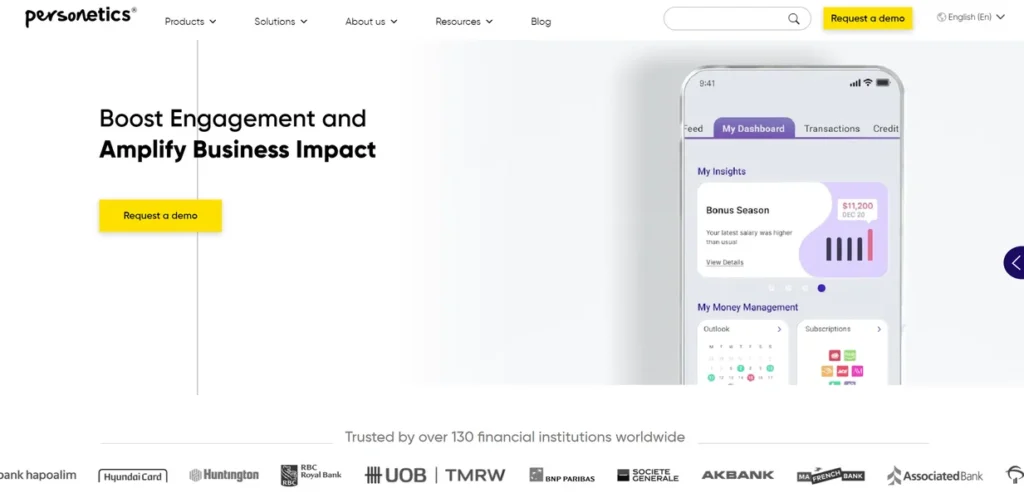
Personetics is an enterprise-grade AI platform designed to serve as a financial data personalization engine for banks and financial institutions. From a technical standpoint, it functions as a sophisticated middleware layer that ingests raw transaction and customer data, enriches it, and applies machine learning models to generate actionable insights. The primary objective is to enable institutions to deliver hyper-personalized digital banking experiences at scale, moving beyond generic notifications to proactive, individualized financial guidance. By integrating with core banking systems, Personetics offloads the heavy lifting of data analysis and insight generation, allowing institutions to focus on the customer-facing application layer while leveraging a powerful, specialized backend for financial intelligence.
Key Features and How It Works
Personetics’ architecture is built around several core components that work in concert to transform raw data into personalized user experiences. Here’s a breakdown from a developer’s perspective:
- Advanced AI and Machine Learning Engine: At its core, Personetics utilizes a suite of algorithms to analyze transactional data streams and user behavior patterns. This engine is responsible for identifying spending habits, predicting cash flow issues, spotting savings opportunities, and delivering personalized financial advice. It’s the brain of the operation, processing vast datasets to find signals in the noise.
- Data Enrichment & Categorization: Think of Personetics’ Data Enrichment like a skilled librarian organizing a chaotic pile of books into a coherent, categorized library. It transforms raw, often cryptic, transaction data (e.g., `AMZNMKTPLACE*MK123`) into clean, understandable information (e.g., `Shopping: Online Marketplace`), making it instantly useful for both the end-user and for downstream analytics. This process is crucial for the accuracy of all subsequent insights.
- Engagement Builder: This feature provides a low-code/no-code console that allows business analysts and marketers to create, test, and deploy custom financial insights without writing a single line of code. For development teams, this significantly reduces the backlog of requests for new features, empowering non-technical staff to iterate on customer engagement strategies independently.
- Robust API and Integration Framework: The platform is designed for deep integration into existing digital banking infrastructures. It offers a comprehensive set of APIs that allow for fetching enriched data, insights, and recommendations to be displayed within a bank’s native mobile or web application. This API-first approach ensures flexibility and allows institutions to maintain full control over their front-end user experience.
Pros and Cons
From an implementation and engineering standpoint, Personetics presents a compelling but challenging proposition.
Pros:
- Technical Scalability: The platform is engineered to handle the transaction volume of major financial institutions, processing millions of events in real-time to deliver timely insights.
- Accelerated Time-to-Market: For institutions looking to deploy advanced personalization features, Personetics offers a pre-built, specialized solution that can be faster than developing a comparable engine in-house.
- Rich Data-Driven Capabilities: The quality of its data enrichment and analytics provides a solid foundation for making informed, strategic decisions about product development and customer segmentation.
- Flexible Integration: The API-centric design allows for seamless integration with modern banking stacks and provides a pathway for connecting with legacy systems.
Cons:
- Integration Complexity: Interfacing with legacy core banking systems can be a significant technical hurdle. This process often requires substantial development resources and careful project management to navigate data mapping and system incompatibilities.
- High Initial Investment: The total cost of ownership, including licensing, implementation, and dedicated engineering resources, can be substantial, making it a better fit for larger institutions with clear ROI objectives.
- Potential for a Learning Curve: While the Engagement Builder is user-friendly, an institution’s technical team will need time to master the API, understand the data models, and learn how to best leverage the platform’s full capabilities.
Who Should Consider Personetics?
Personetics is not a one-size-fits-all solution. It is best suited for established financial institutions with a significant customer base and the technical resources to manage a large-scale integration project. This includes:
- CTOs and Heads of Digital at Major Banks: Leaders aiming to modernize their digital offerings and compete with fintech disruptors by deploying a powerful personalization layer on top of their existing infrastructure.
- Product Managers in Financial Services: Teams tasked with increasing digital engagement, customer retention, and cross-sell opportunities through data-driven features.
- Credit Unions and Regional Banks: Institutions looking to provide a premium, personalized member experience that rivals those of larger banks, provided they have the budget and IT support for implementation.
- Digital-First Banks: Neobanks and digital-only institutions can leverage Personetics to further enhance their tech stack with sophisticated, automated financial wellness tools without building them from scratch.
Pricing and Plans
Detailed pricing information for Personetics was not publicly available. The platform is an enterprise-level solution, and pricing is likely customized based on the size of the institution, the number of customers, and the specific modules or features required. This typically involves a direct sales consultation to assess needs and provide a custom quote. For the most accurate and up-to-date pricing, please visit the official Personetics website.
What makes Personetics great?
Struggling to transform terabytes of raw transaction data into meaningful, real-time customer engagement without overwhelming your core systems? Personetics excels by providing a dedicated, highly specialized engine to solve this exact problem. Its standout capability is the practical application of its ‘Self-Driving Finance’ concept. This isn’t just about showing users a categorized list of expenses; it’s about proactively managing their financial lives by automating savings transfers, providing warnings about upcoming low balances, and identifying opportunities to pay down debt. From a technical perspective, this demonstrates a mature platform that has moved beyond simple data analysis to sophisticated, autonomous financial management, empowering banks to offer a genuinely value-added service that can significantly deepen customer loyalty.
Frequently Asked Questions
- How does Personetics handle data security and privacy?
- Personetics operates under stringent security protocols expected in the financial industry. The platform typically integrates within the bank’s own secure environment, ensuring that sensitive customer data does not leave the institution’s control. It complies with major regulations like GDPR and CCPA.
- What is the typical integration timeline with a legacy core banking system?
- Integration timelines can vary widely based on the complexity of the existing legacy system and the availability of the institution’s technical resources. A typical project can range from several months to over a year, involving phases for data mapping, API integration, testing, and deployment.
- Can the AI models be customized or trained on our institution’s specific data?
- Yes, a key part of the implementation process involves training Personetics’ models on the institution’s specific historical and real-time data. This ensures that the insights and recommendations are tailored to the unique behaviors and characteristics of that institution’s customer base.
- Does Personetics offer a sandbox environment for development and testing?
- Yes, Personetics typically provides a sandbox environment for development teams. This allows engineers to test API integrations, experiment with data flows, and build out the front-end experience without impacting the live production system.