

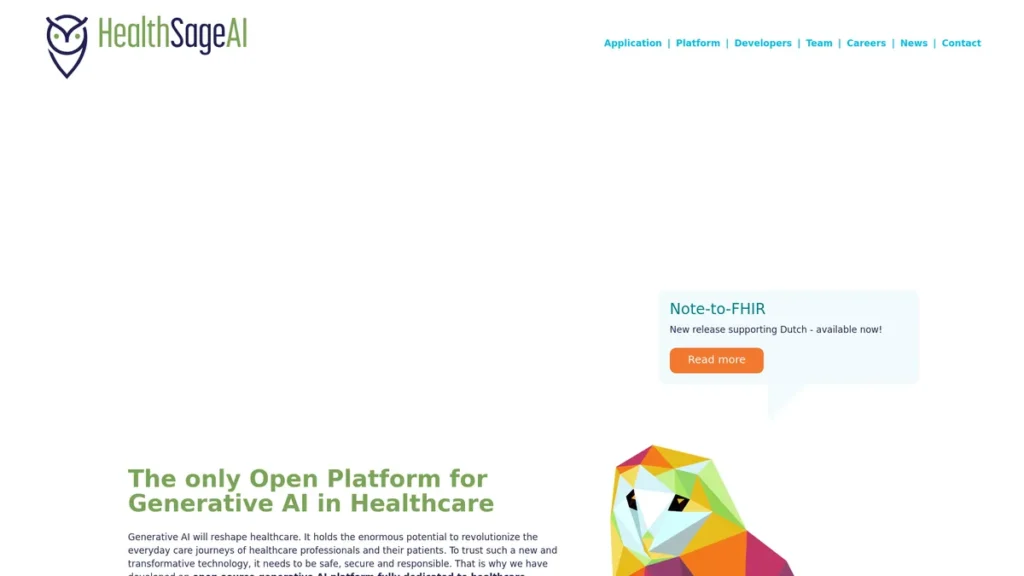
What is HealthSage AI?
For a small business owner in the healthcare space, every new technology promises a revolution but often delivers complexity and high costs. HealthSage AI enters this arena as a cutting-edge platform aiming to integrate generative AI into healthcare, but with a critical difference: it’s an open platform. This means it provides a suite of specialized AI models, tools, and plugins that aren’t locked into a rigid, one-size-fits-all system. It’s designed for healthcare professionals, researchers, and clinics who need transparency and the ability to tailor AI solutions to their specific operational needs, from patient management to complex data analysis.
Key Features and How It Works
HealthSage AI’s value proposition for a business owner hinges on its tangible benefits. It’s not just about advanced technology; it’s about how that technology translates into better performance and lower costs.
- State-of-the-Art Models: The platform includes AI models that, in specific medical contexts, demonstrate higher accuracy than larger, more generalized models like GPT-4. For a practice, this translates directly to more reliable diagnostic support, fewer errors in data processing, and improved patient outcomes.
- Open Source and Customizable: This is the core of its business-friendly approach. Think of it like a professional chef’s kitchen versus a pre-packaged meal kit. A meal kit (a closed AI system) gives you fixed ingredients and instructions. HealthSage AI provides a commercial-grade kitchen where you can bring in your own specialized tools, modify the recipes (the source code), and design a workflow perfectly tailored to your menu, whether that’s patient intake, research analysis, or administrative automation.
- Compliance and Security: HealthSage AI is built with a foundational understanding of strict healthcare regulations. It adheres to rigorous AI governance standards, ensuring that patient data is handled securely and in a compliant manner, reducing a significant source of risk for any practice.
- Resource Efficiency: In practical terms, this means lower operational costs. The models are designed to be less demanding on computing resources, which can lead to direct savings on cloud hosting bills or hardware requirements—a crucial factor for any budget-conscious business.
Pros and Cons
Every tool involves trade-offs, and a pragmatic evaluation is essential before committing.
Pros
- Enhanced Accuracy and Efficiency: Superior accuracy in processing healthcare data improves the speed and quality of services, which can boost a clinic’s reputation and operational flow.
- Cost-Effectiveness: By being more resource-efficient and eliminating licensing fees associated with proprietary software, it offers a tangible path to reducing technology overhead.
- Flexibility and Control: The open platform avoids vendor lock-in. You can integrate it with existing systems via its API and adapt it as your practice grows, ensuring your investment remains relevant.
- Community-Driven Innovation: Businesses benefit from the collective improvements of an active open-source community without funding a massive internal R&D department.
Cons
- Complexity for Non-Technical Users: To unlock its full potential, customization requires technical expertise. A small practice without an IT specialist may need to budget for a consultant, adding to the initial cost.
- Early Development Stage: As a pioneering platform, some of its features remain in beta. This could affect reliability, making it a risk for mission-critical, real-time patient care applications until fully mature.
- Slower Industry Adoption: The healthcare industry is traditionally conservative. As an early adopter, you might find a smaller peer support network compared to users of long-established, mainstream software.
Who Should Consider HealthSage AI?
HealthSage AI is not for everyone. It is best suited for organizations ready to actively engage with technology to build a competitive advantage.
- Tech-Forward Clinics: Small to medium-sized practices with access to IT support that want to create custom workflows for patient management, diagnostics, or billing.
- Medical Researchers: Independent researchers or academic institutions needing powerful, transparent tools for data analysis without the prohibitive cost of proprietary software.
- Healthcare Startups: New companies developing health-tech applications can use HealthSage AI as a flexible and powerful foundation to accelerate their product development.
- Healthcare IT Professionals: In-house IT teams tasked with integrating modern AI capabilities into existing hospital information systems will value its customizability and API access.
Pricing and Plans
HealthSage AI has shifted to a straightforward subscription model to ensure sustainable development and robust support. While a free tier for basic features may have existed previously, the focus is now on providing committed service to professional users.
- Pricing Model: Paid
- Starting Price: $35/month
- Available Plans: The Starter plan is available for $35 per month, designed to provide access to the core models and tools for individual professionals or small teams. For detailed features and enterprise-level pricing, consulting their official website is recommended.
What makes HealthSage AI great?
Are you worried about investing in a rigid AI system that locks you into one vendor and can’t adapt to your clinic’s unique workflow? This is the core problem HealthSage AI solves. Its greatness lies in its combination of openness and specialization. It gives smaller practices and research teams the power to customize their tools with the same level of control typically reserved for large enterprises with massive budgets. By marrying this flexibility with a non-negotiable focus on security, compliance, and clinical accuracy, HealthSage AI provides a transparent and future-proof platform. It’s a strategic asset for building efficiency, not just another piece of software to license.
Frequently Asked Questions
- Do I need a developer to use HealthSage AI effectively?
- For out-of-the-box models and basic applications, a tech-savvy user can manage. However, to truly leverage its customizability and integrate it deeply into your systems, technical expertise or a development partner is highly recommended to maximize your return on investment.
- How does HealthSage AI ensure patient data is secure and HIPAA compliant?
- The platform is designed with security protocols and compliance frameworks at its core. However, as an open platform, ultimate compliance also depends on how you implement and host it. It provides the compliant tools, but your organization is still responsible for deploying them within a secure, HIPAA-compliant infrastructure.
- Can an open-source tool be reliable enough for clinical use?
- Yes. The transparency of open-source code means it is continuously vetted by a global community of experts, often leading to more robust and secure software. HealthSage AI focuses on high-performance models for reliability, but it is crucial to use beta features with caution and conduct thorough testing before deploying in a live clinical setting.
- What kind of ROI can a small practice expect?
- Return on investment comes from multiple areas: increased efficiency by automating administrative tasks, improved diagnostic accuracy leading to better patient outcomes, and significant long-term savings on software licensing and vendor fees compared to proprietary alternatives.