

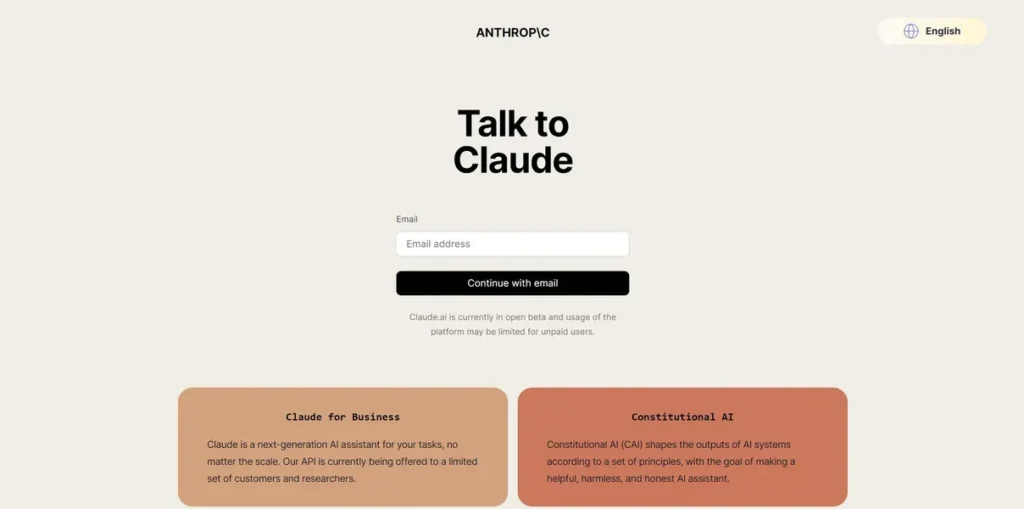
What is Claude 4?
From a software development perspective, Claude 4 is not just another large language model (LLM); it’s an engineering-focused AI developed by Anthropic. Its architecture prioritizes safety, predictability, and the ability to handle exceptionally large contexts. For developers, this translates to a model designed for complex, real-world applications where reliability is non-negotiable. Unlike models geared purely toward creative generation, Claude 4 is engineered for reasoning over extensive datasets, making it a powerful component for enterprise-grade systems. Its API-first design ensures that integration into existing software stacks is straightforward, providing a stable and well-documented endpoint for building sophisticated AI-powered features.
Key Features and How It Works
Claude 4’s capabilities are rooted in a few core technical differentiators that are critical for developers building scalable applications.
- Massive Context Window: The model’s standout feature is its ability to process up to 200,000 tokens in a single prompt. This allows developers to feed entire codebases, lengthy financial reports, or extensive research papers directly into the model. The practical implication is the ability to perform complex analysis, synthesis, and Q&A across vast documents without the need for complex chunking and embedding strategies, simplifying application logic and reducing potential context loss.
- High-Performance API: For production systems, API reliability is paramount. Claude 4 offers a robust API with predictable latency and high throughput. The developer console and comprehensive documentation facilitate rapid implementation, providing clear guidance on authentication, request formatting, and handling streaming responses. This focus on developer experience lowers the barrier to entry for integrating advanced AI capabilities.
- Constitutional AI Framework: At its core, Claude 4 operates on a ‘Constitutional AI’ framework. This is a technical approach to model safety where a set of explicit principles (a ‘constitution’) guides the model’s responses. This method reduces the likelihood of generating harmful, biased, or unsafe output, making the model’s behavior more predictable and controllable—a crucial requirement for applications in regulated industries like finance and healthcare.
- Advanced Vision Capabilities: The model is multimodal, capable of processing and interpreting visual information. For developers, this opens up use cases like analyzing user interface screenshots to generate code, extracting structured data from charts and diagrams, or transcribing text from images. The API provides a unified endpoint for both text and image inputs, simplifying the integration of multimodal functionalities.
Pros and Cons
Pros
- Superior Context Handling: The ability to reason over 200K tokens in a single pass is a significant architectural advantage, enabling applications that are simply not feasible with smaller context windows.
- Enterprise-Grade Safety and Reliability: The Constitutional AI framework provides a level of baked-in safety and predictability that instills confidence when deploying applications to end-users.
- Well-Documented and Stable API: The API is designed for professional developers, offering reliability and clear documentation that accelerates development cycles and simplifies maintenance.
- Lower Hallucination Rates: In benchmark tests and real-world applications, the model demonstrates a lower propensity to ‘hallucinate’ or invent facts, which is critical for analytical and data-driven tasks.
Cons
- Limited Fine-Tuning Accessibility: Compared to competitors, access to model fine-tuning capabilities can be more restricted, which may be a limitation for teams needing to train the model on highly specialized, proprietary datasets.
- Developing Tooling Ecosystem: While growing, the ecosystem of third-party tools, libraries, and integrations is less mature than that of market leaders like OpenAI, potentially requiring more in-house development effort for specific integrations.
- Cost at Scale: Leveraging the full 200K context window for every API call can be computationally expensive. Developers must implement careful token management and cost-optimization strategies for high-volume applications.
Who Should Consider Claude 4?
Claude 4 is best suited for technical teams and businesses with demanding, high-stakes requirements. This includes:
- Enterprise Software Developers: Teams building internal tools for contract analysis, knowledge management, or internal code assistants will benefit immensely from the large context window.
- FinTech and LegalTech Companies: Organizations that process dense, long-form documents require the high accuracy and low hallucination rates that Claude 4 provides.
- R&D and Scientific Institutions: Researchers can use the model to synthesize information across hundreds of pages of academic papers or analyze complex experimental data.
- Customer Support Automation Platforms: Developers can build more sophisticated support bots that maintain context over long, complex customer conversations, drawing from extensive knowledge bases in real-time.
Pricing and Plans
Claude 4 operates on a freemium model. A free tier is available for light usage and experimentation directly through its web interface. For professional use, the Claude Pro plan starts at $20 per month, offering significantly higher usage limits and priority access. For developers building applications, API usage is priced separately on a pay-as-you-go basis, with distinct rates for input and output tokens. This model allows for scalable pricing that aligns with application traffic, but requires careful monitoring and management to control costs, especially when utilizing the model’s largest context window.
What makes Claude 4 great?
Struggling to build reliable AI applications that can process and reason over an entire codebase or lengthy financial report in a single pass? This is precisely where Claude 4 establishes its technical superiority. Its greatness lies not just in its impressive performance on benchmarks, but in its architectural focus on solving large-scale, practical problems. The 200,000-token context window is a structural game-changer, fundamentally altering the types of problems developers can solve. It moves beyond simple Q&A to enable deep, cross-document synthesis and analysis. This, combined with the safety guardrails provided by Constitutional AI, makes Claude 4 a uniquely reliable and powerful component for building the next generation of serious, enterprise-ready AI software.
Frequently Asked Questions
- How does Claude 4’s API compare to other major LLM providers?
- Claude 4’s API is competitive in terms of latency and reliability. It offers official SDKs in Python and TypeScript, simplifying integration. Key differentiators are its support for a very large context window and a strong emphasis on predictable, safe outputs. Rate limits are generally generous but, like all production APIs, require planning for high-throughput applications.
- What are the key considerations when migrating a project from another model to Claude 4?
- Migration requires adapting prompt engineering strategies. Claude 4 responds particularly well to clear, structured prompts with XML tags to delineate instructions and context. Developers should also review the API’s error handling and response structure, which may differ from other providers. Finally, a cost analysis is crucial, as token pricing will vary.
- How does Claude 4 handle data privacy and security for enterprise use?
- Anthropic has a strong focus on enterprise security. Data submitted via the API is not used for training their models by default. They offer zero-data-retention options for enterprise clients and are compliant with standards like SOC 2 Type II, ensuring robust data protection and privacy controls suitable for business-critical applications.
- What programming languages are officially supported by the Claude 4 API?
- Anthropic provides official Software Development Kits (SDKs) for Python and TypeScript/JavaScript, which cover the vast majority of backend and full-stack development use cases. For other languages, developers can interact directly with the REST API using standard HTTP clients.