

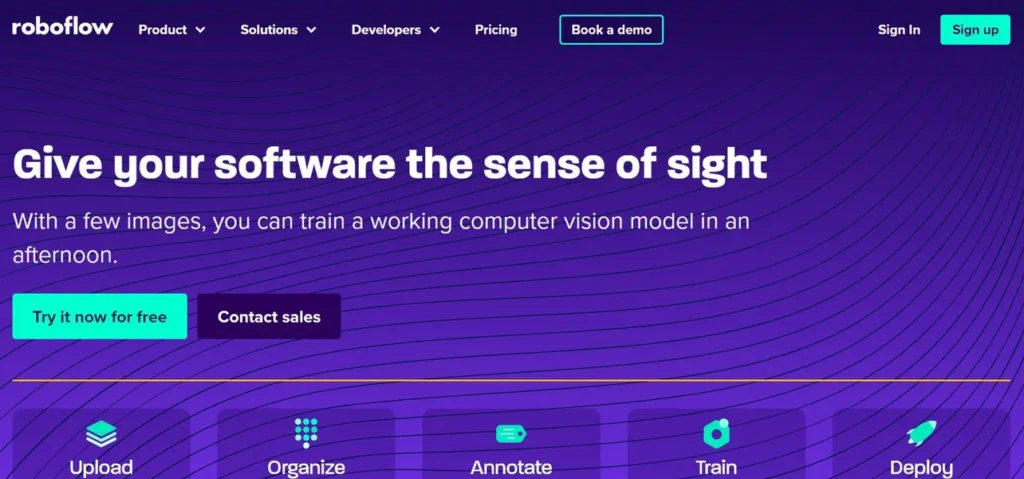
What is Roboflow?
From a senior developer’s standpoint, Roboflow is more than just an AI tool; it’s a comprehensive MLOps platform engineered specifically for computer vision. It systematically tackles the entire project lifecycle, abstracting away the tedious, error-prone infrastructure and data wrangling that bogs down development. In essence, Roboflow allows engineering teams to focus on application logic and model performance rather than pipeline maintenance. It provides a cohesive environment to take raw images, manage their annotation, train a production-grade model, and deploy it as a scalable API endpoint, drastically reducing the time from concept to production.
Key Features and How It Works
Roboflow is built around a logical, four-step workflow: organize, label, train, and deploy. Each stage is supported by a robust set of features designed to maximize efficiency and model accuracy.
- Dataset Management and Augmentation: The platform allows for sophisticated management of image and video data. You can version datasets much like you version code with Git, which is critical for reproducibility. It also offers a powerful suite of preprocessing and augmentation options (e.g., resizing, rotation, color correction) to create more robust models that generalize well to real-world conditions.
- Advanced Annotation Engine: Roboflow includes a browser-based annotation tool that accelerates the labeling process with AI-assistance and smart polygons. For developers, the real power lies in its API, which allows for programmatic annotation and seamless integration with existing data pipelines.
- Integrated Model Training: Think of Roboflow’s training pipeline as a CI/CD system for machine learning. You commit your labeled dataset (your ‘code’), and the platform automatically builds, tests (trains), and prepares the model for deployment. This abstracts away the complexities of GPU allocation, environment configuration, and dependency management, allowing for rapid, one-click training iterations.
- Scalable Deployment Solutions: Once a model is trained, Roboflow offers a spectrum of deployment options. You can instantly deploy to a hosted, scalable cloud API with generated code snippets for multiple languages. For applications requiring low latency or offline capabilities, it supports edge deployments to devices like NVIDIA Jetson, Luxonis OAK, and Raspberry Pi.
Pros and Cons
Pros
- Accelerated Development Lifecycle: The integrated nature of the platform drastically cuts down the time from data collection to a deployed, working model.
- Streamlined MLOps: By unifying data versioning, training, and deployment, Roboflow simplifies the iterative process of model improvement and redeployment.
- Deployment Flexibility: The ability to seamlessly switch between cloud and edge deployment targets without re-architecting the pipeline is a significant technical advantage.
- Robust API and SDK: Offers extensive programmatic control over datasets, projects, and models, enabling deep integration into custom applications and automated workflows.
Cons
- Abstraction Layer Limitations: For highly specialized use cases, the platform’s high level of abstraction may limit fine-grained control over model architecture or training loops.
- Potential Vendor Lock-in: Relying on a single, integrated platform can create dependencies. While Roboflow offers good export options, migrating a complex pipeline is non-trivial.
- Cost at Scale: The pricing model, particularly for API usage and large-scale training, requires careful financial modeling for projects with high throughput demands.
Who Should Consider Roboflow?
Roboflow is an ideal solution for technical teams and professionals who need to build and deploy computer vision capabilities efficiently. Its primary audience includes:
- Software Development Teams: Teams integrating computer vision features into new or existing applications, such as automated quality assurance, inventory management, or interactive user experiences.
- Machine Learning Engineers: Professionals tasked with building and maintaining CV models who want to offload infrastructure management and focus on model iteration and performance.
- Tech Startups: Early-stage companies needing to build and deploy a computer vision-powered MVP quickly and with limited engineering resources.
- Technical Project Managers: Individuals overseeing CV projects who can leverage the platform’s collaborative tools and clear versioning to manage progress and ensure reproducibility.
Pricing and Plans
Roboflow operates on a Freemium model, offering a scalable path from individual experimentation to enterprise-level deployment. The plans are designed to accommodate different project sizes, privacy requirements, and collaboration needs.
- Public Plan: A free tier perfect for students, hobbyists, and open-source projects. It offers access to core features but requires datasets and models to be public.
- Pro Plan: Starting at $249 per month, this plan is tailored for professionals and teams building commercial applications. It includes private projects, increased image and training credits, and access to more advanced deployment options.
- Enterprise Plan: Custom pricing for large organizations. This tier provides enhanced security features like SSO and VPC deployments, unlimited scalability, dedicated support, and options for on-premise solutions.
For the most current and detailed pricing information, it is always best to consult the official Roboflow website.
What makes Roboflow great?
Roboflow’s most powerful feature is its vertically integrated ecosystem that eliminates the friction between data preparation, model training, and production deployment. In a typical development environment, these stages are disconnected, handled by different tools and scripts, which introduces complexity and slows down iteration. Roboflow unifies this entire workflow into a single, cohesive pipeline. This tight integration means a change in the dataset can be seamlessly propagated to a newly trained and deployed model in a fraction of the time, embodying the core principles of MLOps and dramatically accelerating the pace of innovation.
Frequently Asked Questions
- Can I use my own custom model architectures with Roboflow?
- Yes, Roboflow supports bringing your own models. You can upload trained model weights to deploy via Roboflow’s infrastructure or use their API and SDKs to integrate your custom training scripts, while still leveraging their data management and annotation tools.
- How does Roboflow handle data privacy and security?
- Data security is a priority, especially in paid tiers. The Pro plan ensures projects are private. The Enterprise plan adds advanced security measures such as single sign-on (SSO), role-based access controls, and the option for VPC or on-premise deployments to keep data within a company’s own network.
- What level of programming is required to use Roboflow?
- The web UI is accessible to users with minimal coding experience for basic model training. However, to unlock the platform’s full potential—automating workflows via the API, integrating with applications using the SDK, and managing edge deployments—proficiency in Python and a solid understanding of software development principles are essential.
- How easy is it to export my data and models from the platform?
- Roboflow provides robust export functionality to mitigate vendor lock-in. You can download your annotated datasets in dozens of formats compatible with other tools. Trained model weights are also downloadable, allowing you to run inference on your own infrastructure if needed.