

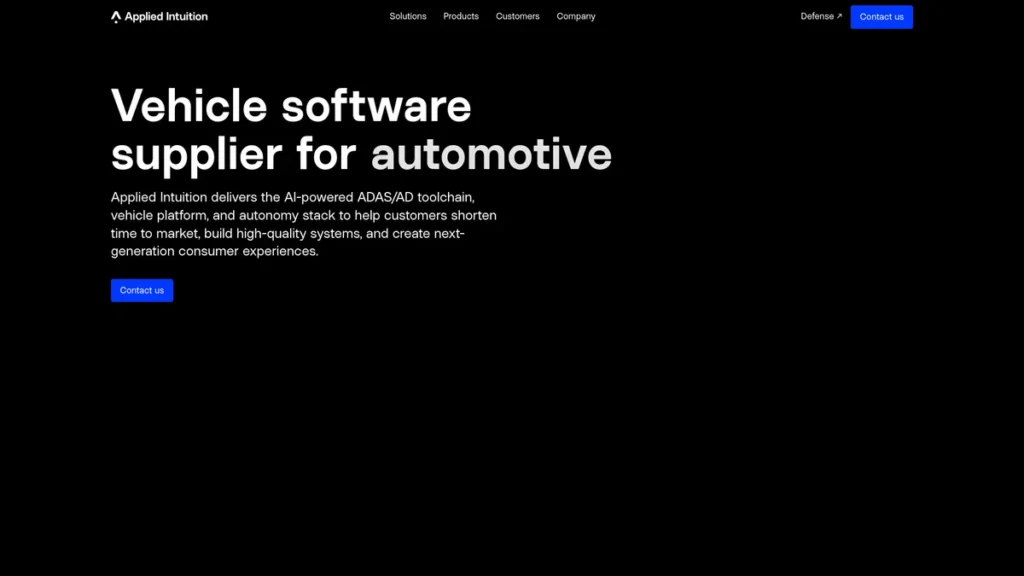
What is Applied Intuition?
Applied Intuition is an end-to-end software development platform engineered for the complexities of autonomous systems. From a technical standpoint, it provides a unified toolchain to accelerate the entire software development lifecycle (SDLC) for advanced driver-assistance systems (ADAS), automated driving (AD), and other vehicle software. The platform is architected to support development across diverse operational design domains, including on-road automotive, off-road agriculture, defense, and mining. For engineering teams, it serves as a critical infrastructure layer, enabling the systematic development, rigorous testing, and secure deployment of mission-critical autonomous software stacks.
Key Features and How It Works
Applied Intuition’s architecture is built around a core set of modular yet integrated tools that address specific stages of the development pipeline. The platform’s functionality can be understood through its primary components:
- ADAS and AD Development Platform: This is the central development environment. It facilitates everything from model-in-the-loop (MIL) and software-in-the-loop (SIL) to hardware-in-the-loop (HIL) testing. Developers can build and test perception, prediction, and control algorithms within a cohesive framework.
- Vehicle Software Platform: This component provides the infrastructure to manage the software architecture of modern, software-defined vehicles. It supports CI/CD pipelines, enabling automated builds, testing, and over-the-air (OTA) updates, which is essential for managing software complexity and deploying features rapidly.
- Off-road Autonomy Stack: A specialized software stack designed for unstructured environments. It offers baseline perception and planning modules that development teams can customize and extend, significantly reducing the initial engineering effort for applications in mining, agriculture, or defense.
- Simulation and Validation Tools: At the platform’s core are its high-fidelity simulation capabilities. It enables deterministic, scalable testing of complex scenarios that are often too dangerous or costly to replicate physically. This includes physics-based sensor simulation (camera, LiDAR, radar) and accurate vehicle dynamics modeling.
- Applied Intuition Copilot: An integrated generative AI assistant that functions within the development environment. It aids engineers by generating boilerplate code, debugging complex issues, and providing contextual information about the platform’s APIs, thereby improving developer velocity.
Pros and Cons
Pros
- High-Fidelity Simulation Environment: The platform’s ability to run deterministic, physics-based simulations at scale significantly reduces the dependency on physical test fleets and allows for comprehensive regression testing.
- Accelerated Development Lifecycle: The integrated toolchain streamlines the path from development to validation, enabling faster iterations and shortening the time-to-market for new autonomous features.
- Robust Integration and API Support: Extensive API access and support for HIL setups allow teams to seamlessly integrate the platform into existing workflows, toolchains, and hardware configurations.
- Technical Scalability: The architecture is designed to manage the immense complexity and data requirements of large-scale autonomy programs, supporting large engineering teams working in parallel.
Cons
- Significant Learning Curve: The platform’s depth and technical complexity require a substantial investment in training for engineering teams to leverage its full capabilities effectively.
- High Infrastructure Dependency: To achieve optimal performance, especially for large-scale simulations, organizations must commit significant computational resources, which can be a barrier to entry.
- Potential for Vendor Lock-in: Deep integration with such a comprehensive, end-to-end platform can create technical dependencies that may complicate future migrations to alternative tools or in-house solutions.
Who Should Consider Applied Intuition?
Applied Intuition is best suited for organizations with dedicated engineering teams working on sophisticated autonomous systems. Key users include:
- Automotive OEMs and Tier 1 Suppliers: Engineering departments responsible for the verification and validation (V&V) of ADAS and AD software stacks who require a scalable and reliable testing solution.
- Defense and Aerospace Contractors: R&D teams developing autonomous ground vehicles (AGVs) or other unmanned systems that need robust simulation capabilities for unstructured, off-road environments.
- Mining and Agriculture Technology Companies: Software developers building autonomous machinery who must test perception and control algorithms against highly variable and unpredictable operational conditions.
- Autonomous Vehicle Startups: Early and growth-stage companies that can leverage a pre-built simulation and testing infrastructure to accelerate product development without the massive overhead of building a proprietary toolchain.
Pricing and Plans
Detailed pricing for Applied Intuition was not publicly available. The platform operates on an enterprise-level, custom pricing model tailored to the specific needs, scale, and industry of each client. This typically involves licensing fees based on the number of users, the scope of platform modules required, and the level of integration support. For the most accurate and up-to-date pricing, please visit the official Applied Intuition website.
What makes Applied Intuition great?
What makes Applied Intuition an indispensable tool for engineers is its end-to-end, high-fidelity simulation and validation environment. This comprehensive suite allows development teams to manage the entire software lifecycle within a single, cohesive platform. The ability to systematically design, execute, and analyze tests against a vast library of virtual scenarios—including critical edge cases and fault injections—provides a level of rigor and scalability that is unattainable with physical testing alone. For a developer, this means a more robust, reliable, and faster path from code commit to validated deployment in a safety-critical system.
Frequently Asked Questions
- How does Applied Intuition handle sensor simulation?
- Applied Intuition provides high-fidelity, physics-based models for a range of sensors, including cameras, LiDAR, and radar. This enables engineering teams to generate realistic synthetic data to train and test perception algorithms against a wide variety of environmental and lighting conditions.
- Can we integrate our own vehicle dynamics models into the platform?
- Yes, the platform is built with extensibility in mind. It provides robust APIs and supports industry-standard formats like FMU/FMI, allowing teams to import and use their own custom vehicle dynamics models to ensure simulations accurately reflect the behavior of their specific hardware.
- Does the platform support CI/CD workflows for automotive software?
- Absolutely. Applied Intuition is designed to integrate directly into modern CI/CD pipelines. This enables automated simulation-based testing for every software change, a critical capability for maintaining code quality and ensuring safety in software-defined vehicle development.
- What level of support is provided for custom integrations?
- Applied Intuition offers comprehensive support, including extensive API documentation and access to field engineering teams to assist with integrating the platform into existing toolchains, data storage systems, and other proprietary software infrastructure.