

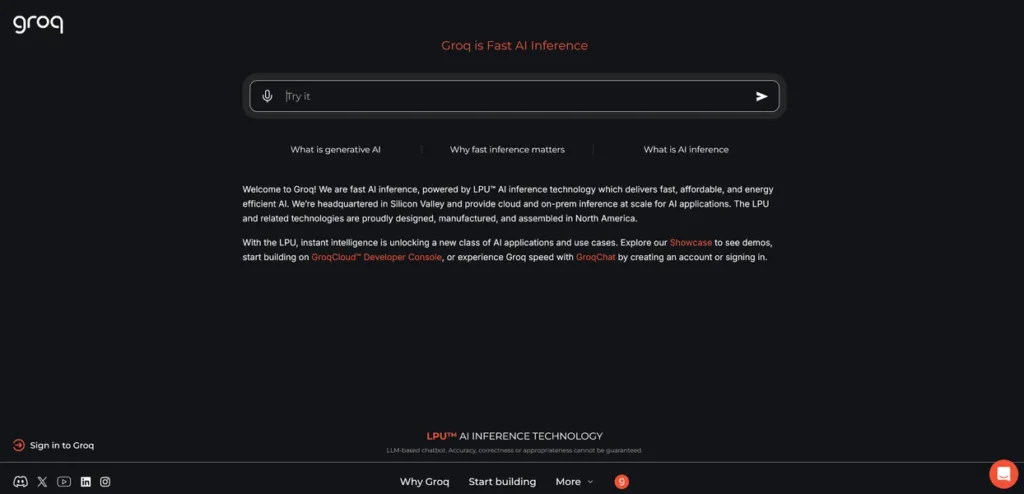
What is Groq?
In a market saturated with AI solutions, Groq carves out a specific niche: speed. For a business owner, this isn’t about abstract benchmarks; it’s about tangible performance. Groq is an AI systems company that has developed a specialized processing architecture, the Language Processing Unit (LPU™), designed to run AI models at exceptionally high speeds. Unlike general-purpose processors, Groq’s technology is purpose-built for the demands of AI inference—the process of using a trained model to make a prediction. In practical terms, this means faster chatbot responses, instantaneous data analysis, and real-time operational capabilities that can directly impact your customer experience and bottom line.
Key Features and How It Works
Groq’s value proposition is built on a foundation of specialized hardware and a cloud-based delivery model. Understanding its core components is key to evaluating its potential ROI for your business.
- Extreme Low-Latency Inference: The primary benefit of Groq is its ability to dramatically reduce the time it takes for an AI model to produce a result. This is crucial for applications where immediate feedback is required, such as interactive customer service agents or real-time fraud detection.
- LPU™ (Language Processing Unit) Technology: This is Groq’s core innovation. Think of a standard GPU as a versatile workshop capable of handling many different jobs reasonably well. In contrast, the LPU is a hyper-specialized, automated assembly line designed for one task only: processing AI computations with maximum speed and efficiency. This singular focus eliminates many of the bottlenecks found in generalist hardware, resulting in predictable, ultra-fast performance.
- Scalable Architecture: As your business grows, so do your data processing needs. Groq is designed to scale, meaning it can handle a surge in user activity or data volume without a corresponding drop in performance. This ensures reliability during peak business hours or periods of rapid growth.
- GroqCloud API Access: For most businesses, purchasing and managing specialized hardware is impractical. GroqCloud provides access to the power of LPUs via a simple API. This allows your development team to integrate Groq’s speed into your existing applications without a massive upfront investment in physical infrastructure.
Pros and Cons
No technology is a perfect fit for every scenario. A clear-eyed assessment of Groq’s strengths and weaknesses is essential for any business owner considering the platform.
Pros
- Unmatched Speed: Groq offers performance that can be orders of magnitude faster than traditional GPU-based systems for specific AI inference tasks, enabling truly real-time applications.
- Predictable Performance: The deterministic nature of the LPU architecture means latency is consistent, allowing for reliable service level agreements (SLAs) for your customers.
- Operational Efficiency: By processing tasks faster, the LPU can be more power-efficient than other solutions, potentially leading to lower operational costs at scale.
Cons
- Niche Application: Groq is highly specialized for AI inference. It is not a general-purpose computing solution and is not designed for training AI models.
- High Cost of Entry: Access to cutting-edge performance comes at a premium. The cost may be prohibitive for small businesses or projects where extreme low latency isn’t a critical revenue driver.
- Steep Learning Curve: Integrating and optimizing for a new hardware architecture requires specialized technical expertise. This is not a plug-and-play solution and will require investment in skilled engineering talent.
Who Should Consider Groq?
Groq is not a tool for every business. It is a strategic investment for organizations whose core business model or customer experience hinges on millisecond-level AI performance. Consider Groq if you are:
- A company developing highly interactive AI agents or chatbots where conversational flow cannot be interrupted by lag.
- A financial services firm that requires real-time fraud detection or algorithmic trading analysis.
- A tech startup building a product where speed is the primary competitive differentiator.
- An e-commerce platform looking to implement instantaneous, complex product recommendations based on live user behavior.
If your AI needs are limited to back-office analytics or non-customer-facing tasks where a few seconds of processing time is acceptable, the ROI for Groq will be difficult to justify.
Pricing and Plans
At the time of this review, specific pricing information for Groq’s services was not publicly available. The platform operates on a custom pricing model, tailored to the specific computational needs and scale of each client. This approach is typical for enterprise-grade, high-performance infrastructure. You will need to engage with their sales team to discuss your use case and receive a detailed quote. For the most accurate and up-to-date pricing, please visit the official Groq website.
What makes Groq great?
Tired of AI applications that feel sluggish and disconnected? The most significant factor that makes Groq a game-changer is its uncompromising focus on solving the AI latency problem. While many companies build processors that are jacks-of-all-trades, Groq has engineered a master of one: inference speed. This singular dedication results in a product that doesn’t just offer incremental improvement; it enables entirely new kinds of real-time applications that were previously impractical. For businesses competing on user experience, Groq provides a powerful, if costly, tool to deliver truly instantaneous AI-powered services.
Frequently Asked Questions
- What is the main difference between Groq’s LPU and a standard GPU?
- The primary difference is specialization. A GPU (Graphics Processing Unit) is a versatile processor that is good at many parallel tasks, including AI. An LPU (Language Processing Unit) is a specialized processor architected exclusively for the sequential nature of AI inference, making it significantly faster and more efficient for that specific job.
- Do I need a machine learning expert on my team to use Groq?
- Yes. Groq provides powerful infrastructure, but it is not a low-code or no-code platform. You will need developers or ML engineers who can work with APIs and understand how to deploy and optimize AI models to effectively leverage its capabilities.
- Can a small business realistically afford Groq?
- While the cost is high, accessing the technology via the GroqCloud API makes it more accessible than purchasing hardware outright. A small business with a well-defined, high-value use case where speed directly translates to revenue could see a positive ROI. It requires careful cost-benefit analysis.
- Is Groq only for large language models (LLMs)?
- While LLMs are a prominent use case due to their sensitivity to latency, Groq’s LPU can accelerate inference for a wide range of AI models, including those used for computer vision, speech recognition, and other predictive tasks that require real-time results.