

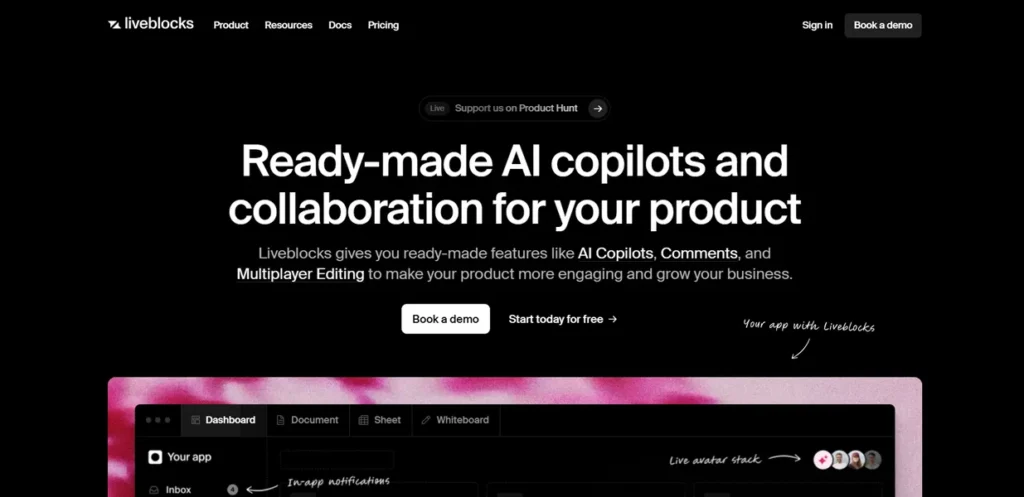
What is Liveblocks?
Liveblocks is a development platform that provides the building blocks for creating real-time collaborative experiences and AI-powered copilots within your own applications. For a business owner, this isn’t a standalone product your team uses, but rather a toolkit your developers integrate into your software. The primary business case is to increase your product’s value by enabling features similar to those found in Google Docs or Figma, such as simultaneous editing and live cursors. By adding these interactive elements, the goal is to improve user engagement and retention, making your application an indispensable part of your customers’ workflow. It aims to transform static, single-user applications into dynamic, multi-user environments without requiring you to build the complex underlying infrastructure from scratch.
Key Features and How It Works
Liveblocks operates by providing a set of APIs and components that your development team can use. These components handle the difficult backend work of managing connections, syncing data, and ensuring low latency. Here’s a breakdown of its core features from a business perspective:
- AI Copilots: This feature allows you to embed AI agents directly into your application. These agents can provide assistance to users, automate tasks, or generate content. The tangible benefit is a reduction in customer support requests and an improved user onboarding process, as the AI can guide new users through complex features.
- Multiplayer Editing: This is the functionality that allows multiple users to edit the same content simultaneously. For any software that involves creating or managing information, this feature can significantly increase its utility. It works by synchronizing user inputs across all clients in real-time, directly boosting the productivity of teams who use your product.
- Real-time Presence Indicators: This includes features like live cursors, avatars of who is currently viewing a document, and selection indicators. While seemingly cosmetic, these elements create a sense of a shared workspace, encouraging more active collaboration and making your application feel more responsive and alive. This can directly translate to longer and more frequent user sessions.
- Smart Alerts and Notifications: This system intelligently notifies users of relevant activities, such as mentions or document updates. For a business, this is a powerful re-engagement tool that brings users back to your platform for meaningful reasons, increasing daily active use.
Pros and Cons
Evaluating Liveblocks requires a clear-eyed look at its direct impact on your business operations and bottom line.
Pros
- Reduced Development Costs: Building real-time infrastructure is expensive and time-consuming. Liveblocks provides this out of the box, allowing your developers to focus on your core product features instead of reinventing the wheel. This translates directly to lower payroll costs and faster time to market.
- Increased User Engagement and Retention: Interactive, collaborative features make software ‘stickier.’ When users can work together effectively within your tool, they are less likely to seek alternatives.
- Scalable Infrastructure: The platform is designed to handle growth. As your user base expands, you won’t need to worry about the collaborative features failing, saving you from costly infrastructure overhauls down the line.
- Enterprise-Grade Security: With SOC 2 and HIPAA compliance available, Liveblocks enables you to serve markets with stringent data security requirements, potentially opening up new revenue streams.
Cons
- Requires Technical Expertise: This is not a no-code solution. You need skilled developers to integrate the Liveblocks SDK and build the front-end experience. This represents a significant upfront investment of time and resources.
- Vendor Lock-in: By building a core part of your application on Liveblocks, you become dependent on their service, pricing, and uptime. Migrating away from it in the future would be a complex and expensive project.
- Limited Off-the-Shelf Integrations: While the API is flexible, Liveblocks has a limited number of pre-built integrations with other services. This could mean more custom development work is needed to connect it to your existing tech stack.
Who Should Consider Liveblocks?
Liveblocks is not a one-size-fits-all solution. It offers the most value to specific types of businesses:
- SaaS Companies: Any software-as-a-service business whose product involves content creation, project management, or data analysis can gain a significant competitive edge by integrating real-time collaboration.
- EdTech Platforms: Companies creating virtual classrooms or interactive learning tools can use Liveblocks to build more engaging and collaborative educational experiences for students and teachers.
- Internal Tool Developers: Larger companies building custom internal software can use Liveblocks to improve employee productivity and streamline workflows without a massive engineering investment.
Conversely, businesses with simple, non-collaborative applications or those without available developer resources should likely avoid this tool, as the cost and complexity of implementation would outweigh the benefits.
Pricing and Plans
Liveblocks operates on a freemium model, making it accessible to test before committing significant budget.
- Free Plan: This plan is available at no cost and is designed for small projects, proofs of concept, or hobbyist developers. It provides access to the core real-time infrastructure and pre-built components for a limited number of monthly active users.
- Pro Plan: Starting at $15 per month, this plan is designed for businesses launching or scaling a product. It includes a higher allowance for monthly active users, more simultaneous connections per room, and email support. The pricing is usage-based, so costs will scale as your application’s user base grows.
- Enterprise Plan: This plan offers custom pricing for large-scale applications with extensive user bases. It includes features like volume discounts, multi-region hosting, a 99.9% uptime SLA, and compliance with standards like SOC 2 and HIPAA.
What makes Liveblocks great?
The single most powerful feature of Liveblocks is its ability to reduce development time for complex, real-time features from months to days. For a small business, this is a critical advantage. It directly accelerates your product roadmap and allows you to deliver a modern, competitive user experience on a fraction of the budget it would take to build from scratch. By handling the complex backend infrastructure for real-time data synchronization, Liveblocks allows your engineering team to focus their limited resources on solving problems unique to your customers. The addition of its AI Copilot toolkit provides a clear path to integrating intelligent, helpful features that can further differentiate your product and reduce your operational overhead.
Frequently Asked Questions
- How much developer time does Liveblocks actually save?
- Building stable, low-latency real-time infrastructure is a multi-month project for a dedicated team of engineers. With Liveblocks, a developer can often implement core collaborative features like live presence and basic multiplayer editing in a matter of days or weeks, representing a cost saving of tens of thousands of dollars in engineering salaries.
- Is it secure enough for my customer data?
- Yes. On its Enterprise plan, Liveblocks is SOC 2 compliant and can be configured for HIPAA compliance, meeting high standards for data security and privacy. This makes it a viable option for applications in regulated industries like healthcare and finance.
- What happens if Liveblocks has an outage?
- An outage at Liveblocks would mean the collaborative features of your application would stop working. The Enterprise plan offers a 99.9% uptime Service Level Agreement (SLA), which provides a contractual guarantee of reliability and credits in case of downtime.
- Can I integrate this with my existing user authentication system?
- Yes. Liveblocks is designed to work with your existing authentication. Your server authenticates users as it normally would and then grants them a token to access Liveblocks’ services, ensuring a secure and seamless integration.