

What is Skyflow?
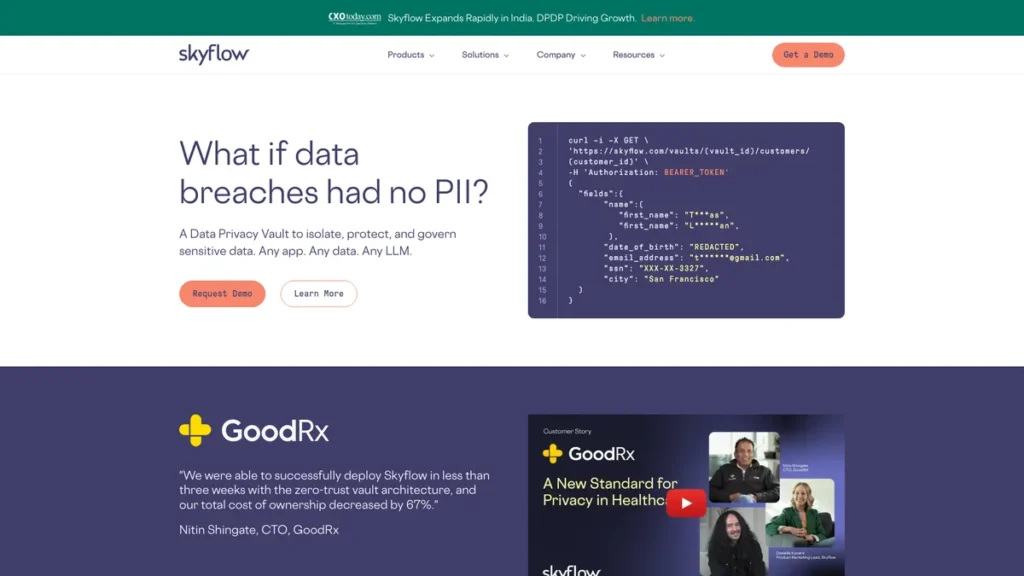
As a business owner, you’re likely juggling a dozen priorities, and data security regulations probably feel like another complex, expensive problem to solve. Skyflow positions itself as a specialized solution to this headache. In essence, it’s a data privacy vault delivered via an API. Instead of storing sensitive customer information like credit card numbers or health records directly in your databases or applications, you send it to Skyflow’s secure vault. Your systems then interact with a safe, tokenized version of that data, isolating the real information from potential threats and simplifying your path to compliance with standards like PCI, HIPAA, and GDPR.
Key Features and How It Works
Skyflow’s functionality is built around the idea of isolating sensitive data without sacrificing its utility. Here’s how its core features deliver on that promise from a practical business standpoint.
- Data Privacy Vault: At its core, Skyflow provides a secure, isolated environment for your most sensitive data. By using its API, you can securely collect, store, and tightly control access to PII, PHI, and other confidential information, effectively taking it off your primary infrastructure and reducing your compliance scope.
- Tokenization: This is a crucial feature for any business processing payments or personal data. Think of tokenization like a coat check ticket. You hand over your valuable coat (sensitive data) and get a simple ticket (a token). The ticket itself is useless to a thief, but you can use it to retrieve your coat when needed. Skyflow replaces raw data with these tokens, which can be safely used in your workflows without exposing the actual information, drastically minimizing the damage of a potential data breach.
- Polymorphic Encryption: This advanced feature allows your data to remain encrypted even while it’s being used for analytics or processing. It enables different teams to work with sensitive data sets in a protected format, ensuring that privacy is maintained without bringing operations to a halt.
- LLM Data Protection: If you’re exploring AI, you know that training models on real customer data is a minefield. Skyflow offers a specific solution to identify and redact sensitive information before it ever reaches a Large Language Model (LLM), helping you innovate responsibly without compromising user privacy.
Pros and Cons
No tool is a perfect fit for everyone. Here’s a balanced look at Skyflow from a small business owner’s perspective.
Pros:
- Reduced Compliance Burden: Offloading the storage of sensitive data can significantly simplify achieving and maintaining compliance with strict regulations like PCI and HIPAA, saving both time and money on audits.
- Enhanced Security and Trust: A data breach can be fatal for a small business. By isolating data, Skyflow provides a robust security layer that protects your reputation and builds customer trust.
- Operational Flexibility: Unlike some security solutions that lock data away, Skyflow’s use of tokenization and special encryption allows you to still use your data for analytics and business operations securely.
Cons:
- Technical Implementation: As an API-first product, Skyflow requires developer resources to integrate. It’s not a simple plug-and-play solution, which can be a barrier for non-technical teams or businesses without an in-house developer.
- Potential Cost: Custom pricing models can be opaque and often cater to enterprise-level budgets. Small businesses will need to engage with the sales team to determine if the ROI justifies the cost.
- Vendor Lock-in Concern: Building your data privacy infrastructure around a third-party vault means you become dependent on that service. A thorough evaluation of their reliability and support is critical.
Who Should Consider Skyflow?
Skyflow is not for every business. It is most valuable for organizations that handle highly sensitive data as a core part of their operations. This includes:
- Fintech and E-commerce Businesses: Any company processing payments or financial data can use Skyflow to simplify PCI compliance and secure customer information.
- Health Tech Companies: Startups and providers dealing with Protected Health Information (PHI) can leverage the vault to meet strict HIPAA requirements.
- SaaS Companies: Any B2B or B2C software company that handles Personally Identifiable Information (PII) across global jurisdictions can use Skyflow to manage data residency and privacy rules.
- Companies Using AI/LLMs: Businesses looking to safely leverage customer data for AI model training without exposing sensitive details.
Conversely, if your business handles minimal sensitive data or lacks the technical resources for API integration, a lighter-weight solution might be more appropriate.
Pricing and Plans
Skyflow utilizes a custom pricing model tailored to the specific data volume, features, and compliance needs of each organization. This means there are no publicly listed pricing tiers on their website. You will need to contact their sales team and schedule a demo to receive a personalized quote based on your requirements. For the most accurate and up-to-date pricing, please visit the official Skyflow website.
What makes Skyflow great?
Are you worried that your company’s growth will be stalled by the ever-increasing complexity of data privacy laws? What makes Skyflow a compelling solution is its foundational approach to privacy. Instead of treating security as a feature you add on later, Skyflow allows you to build your applications with a privacy-by-design architecture from day one. Its API-first nature means it integrates deeply into your workflows, acting as a central, secure hub for all sensitive data. This centralization provides a single point of control and governance, making it far easier to manage, audit, and secure data compared to having it scattered across various databases and services. It transforms data privacy from a reactive compliance checklist into a proactive, manageable part of your infrastructure.
Frequently Asked Questions
- Do I need a developer to implement Skyflow?
- Yes. Skyflow is an API-based platform designed for developers to integrate into applications and systems. You will need technical expertise to set it up and manage its connections to your existing tech stack.
- Is Skyflow just for large enterprises?
- While it offers enterprise-grade features, Skyflow is designed to be scalable. Startups and small businesses in regulated industries like finance and healthcare are prime candidates. However, the cost and technical requirements must be evaluated to ensure it’s a good fit for your budget and team.
- How does Skyflow help with data residency laws like GDPR?
- Skyflow allows you to specify where your data is physically stored. You can configure your vault to keep EU citizen data within the EU or meet other regional data residency requirements, which is a critical component of global compliance.
- What’s the difference between Skyflow and just encrypting my own database?
- Standard database encryption protects data at rest. Skyflow goes further by isolating the data in a separate vault, using tokenization to de-risk your primary systems, and providing advanced encryption that protects data even when it’s in use. It also adds a crucial layer of governance and audit trails for compliance purposes.