

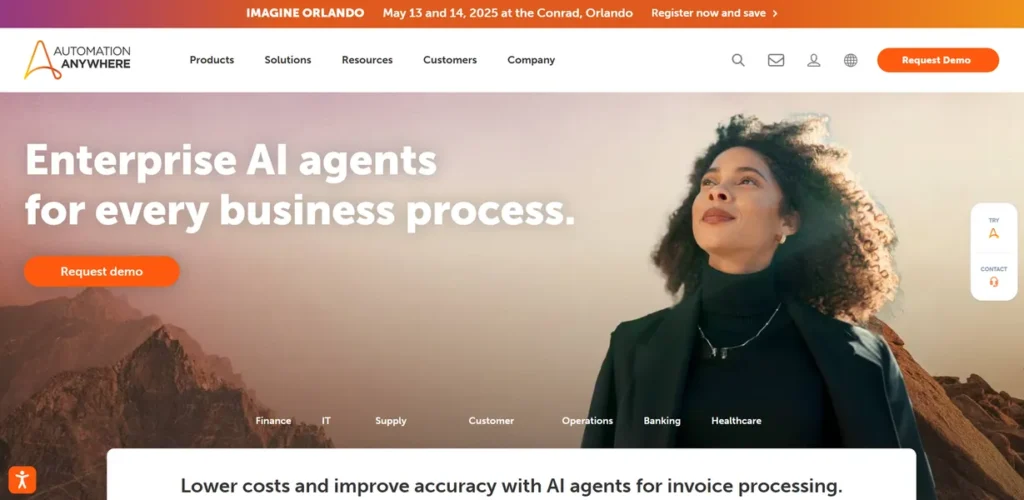
What is Automation Anywhere?
From a developer’s standpoint, Automation Anywhere is a comprehensive, enterprise-grade platform for architecting, deploying, and managing intelligent automation at scale. It transcends basic Robotic Process Automation (RPA) by integrating a sophisticated AI layer, enabling the creation of software “bots” or AI agents that can handle both structured and unstructured data. It provides a full-lifecycle development environment designed for high-availability, mission-critical business processes. The platform’s core value lies in its ability to serve as a robust middleware, bridging modern, API-driven applications with legacy systems that lack integration points, all while maintaining stringent security, governance, and auditability standards essential for enterprise operations.
Key Features and How It Works
Automation Anywhere’s architecture is built on a set of powerful components that work in concert to deliver scalable automation. Here’s a technical breakdown:
- Agentic Process Automation System: This is the platform’s orchestration engine. It acts as a central nervous system for connecting disparate systems and managing complex, multi-step workflows. Developers can define intricate process flows that involve API calls, database interactions, UI automation, and human-in-the-loop approvals, all managed and monitored from a central control room.
- AI Agent Studio: This component is essentially an integrated development environment (IDE) for automation. Think of it like a specialized IDE such as Visual Studio Code, but built specifically for creating AI agents. It provides a low-code, drag-and-drop interface for rapid prototyping by business analysts, but also allows professional developers to dive deeper, embedding custom scripts (e.g., Python, VBScript) and making direct API calls for more complex logic and integrations. This dual-capability makes it a versatile tool for cross-functional development teams.
- Automation Co-Pilot: This is an embedded, user-facing agent that can be integrated directly into third-party business applications. From a technical perspective, it functions as a callable service or an embedded client that allows users to trigger complex backend automations on-demand. This democratizes automation, enabling non-technical users to leverage powerful, pre-built bots without leaving their primary work environment.
- AI Document Automation: This is a specialized service that combines Optical Character Recognition (OCR), Natural Language Processing (NLP), and machine learning models to extract and structure data from documents like invoices, contracts, and forms. It essentially provides a data ingestion pipeline, transforming unstructured data into a structured format (like JSON) that can be easily consumed by other APIs and automated workflows, eliminating a major bottleneck in many business processes.
Pros and Cons
Pros
- High Scalability: The platform is architected for enterprise scale, featuring robust workload management, bot orchestration, and a cloud-native infrastructure that can handle thousands of concurrent automated processes.
- Extensive Integration Hooks: With a vast library of pre-built connectors and a well-documented API, it excels at integrating into complex enterprise ecosystems, acting as a powerful orchestration layer between various SaaS, on-prem, and legacy applications.
- Enterprise-Grade Security & Governance: It offers critical features like credential vaulting, role-based access control (RBAC), and detailed audit logs, which are non-negotiable for deploying automation in regulated industries.
- Developer-Friendly Abstractions: The AI Agent Studio and support for custom scripting allow development teams to build reusable components and complex logic, moving beyond simple task automation to create sophisticated software solutions.
Cons
- Steep Abstraction Curve: While the low-code interface facilitates a quick start, mastering the platform’s advanced features, architectural best practices, and API for building truly resilient, scalable bots requires a significant learning investment.
- Architectural Overhead for Simple Tasks: For small businesses or isolated use cases, the platform’s comprehensive governance and orchestration framework can be overkill, introducing unnecessary complexity and resource consumption compared to lighter scripting solutions.
Who Should Consider Automation Anywhere?
Automation Anywhere is engineered for organizations with complex operational landscapes. It’s an ideal fit for:
- Enterprise IT and Development Teams: Professionals tasked with modernizing legacy systems, integrating disparate applications, and building internal process automation tools will find its robust API and governance features invaluable.
- DevOps and SRE Teams: These teams can leverage the platform to automate infrastructure provisioning, application monitoring, and complex incident response workflows that span multiple systems.
- Organizations Undergoing Digital Transformation: Companies looking to build a scalable, centralized, and governable automation practice (a Center of Excellence) will benefit from its structured, enterprise-first approach.
- Data Engineering Teams: Teams that need to build sophisticated data pipelines involving unstructured document processing will find the AI Document Automation feature particularly powerful for ingestion and structuring tasks.
Pricing and Plans
Specific pricing and plan details for Automation Anywhere’s enterprise solutions were not publicly available. The company offers customized quotes based on the scale of deployment, the number of bots, and the specific features required. They also provide a free Community Edition, which is an excellent starting point for individual developers and small teams to explore the platform’s core functionalities and developer experience. For the most accurate and up-to-date pricing, please visit the official Automation Anywhere website.
What makes Automation Anywhere great?
The single most powerful feature of Automation Anywhere is its enterprise-grade, API-first approach to integration and scalability. While many tools focus solely on UI-based automation, Automation Anywhere provides a robust framework that prioritizes system-level integration through APIs, resorting to UI interaction only when necessary (e.g., for legacy systems). This dual approach ensures that automations are more stable, faster, and less brittle than those relying purely on screen scraping. This philosophy, combined with its centralized governance and security controls, transforms the platform from a simple task automator into a strategic tool for building a resilient, scalable, and manageable automation fabric across an entire organization.
Frequently Asked Questions
- How does Automation Anywhere handle version control and deployment?
- Automation Anywhere incorporates version control directly within its Control Room, allowing teams to track changes, view revision history, and revert bots to previous versions. Deployments are managed through environments (e.g., Development, Test, Production), enabling a structured promotion process that aligns with standard CI/CD and software development lifecycle (SDLC) best practices.
- Can I integrate custom Python or JavaScript code into my automations?
- Yes, the platform offers strong support for custom scripting. Developers can embed and execute Python and JavaScript code directly within automation workflows, enabling complex data manipulation, custom logic implementation, and interaction with external libraries or SDKs that are not available as pre-built connectors.
- What is the difference between RPA in Automation Anywhere and traditional API integration?
- API integration involves direct, system-to-system communication via a defined contract, making it exceptionally fast and reliable. RPA, particularly UI automation, simulates human interaction with a graphical user interface (GUI) to perform tasks. Automation Anywhere excels by combining both; it encourages an API-first strategy for stability and performance but provides world-class RPA capabilities as a powerful method to integrate with applications that lack APIs, offering a complete and versatile integration toolkit.