

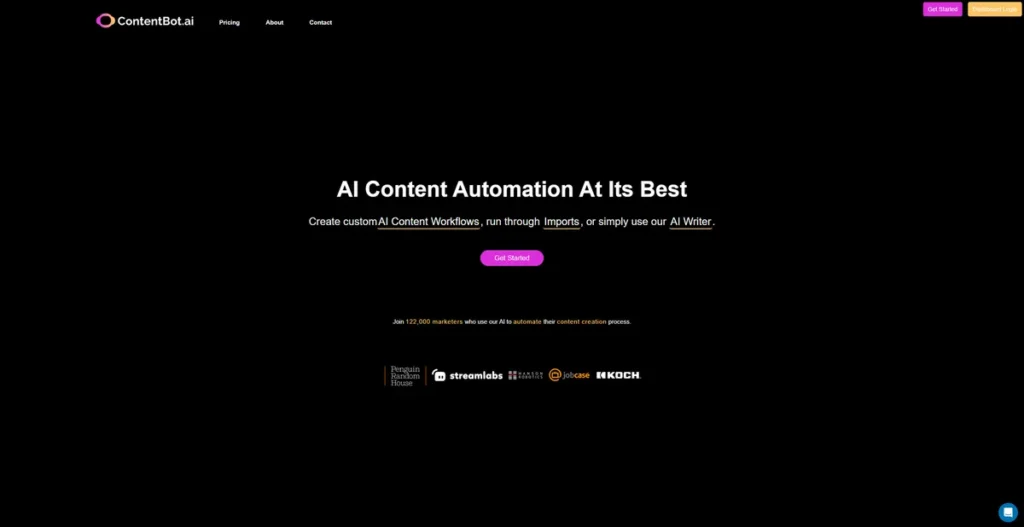
What is ContentBot?
In the crowded market of AI writing assistants, every tool claims to be a game-changer. ContentBot enters this space with a specific focus: transforming content creation from a manual task into an automated workflow. For a small business owner, this promise translates directly to potential savings in time and labor costs. The platform is an AI-driven tool designed to generate a wide range of written materials, from blog posts and ad copy to full-scale marketing campaigns. The core value proposition isn’t just about writing faster; it’s about building repeatable systems for content production. It aims to serve as a functional asset for marketers, founders, and copywriters who need to produce consistent, high-volume content without a proportional increase in headcount or budget.
Key Features and How It Works
ContentBot’s utility for a business is best understood by examining its core functions. These aren’t just features for their own sake; they are tools designed to solve specific operational bottlenecks in content production.
- AI Content Flows: This is the platform’s workflow automation engine. A business can build a custom, step-by-step process for the AI to follow. For example, you could create a ‘Flow’ that takes a product name, generates five feature descriptions, writes a short social media post for each, and then drafts an introductory email. You set it up once and reuse it, standardizing your output.
- AI Importer: This feature works in tandem with Flows to handle bulk tasks. You can upload a CSV file with hundreds of blog post titles or product keywords, and the AI will process the entire list through a pre-defined Flow, generating all the required content in a single operation. This is designed for tasks like creating product descriptions for an entire e-commerce catalog.
- AI Writer: This is the more conventional component, a versatile editor for generating specific pieces of content on demand. It includes templates for marketing copy, articles, and other common business needs.
- Multi-Language Support: The ability to generate content in over 110 languages is a practical feature for businesses looking to test or enter international markets without the immediate high cost of professional translation services for initial marketing materials.
Pros and Cons
Evaluating ContentBot requires a practical look at its potential return on investment versus its operational costs and limitations.
Pros
- Efficiency Gains: The primary benefit is a significant reduction in the time spent on repetitive writing tasks. Automating content workflows directly translates to lower labor costs or frees up staff for higher-value strategic work.
- Scalable Content Production: The tool allows a small team to produce the content volume of a much larger one. For businesses in a growth phase, this scalability is a significant operational advantage.
- Cost-Effectiveness: The entry-level pricing plan is accessible for small businesses, providing a low-risk opportunity to test the platform’s impact on productivity before committing to higher-tier plans.
- Ease of Use: Despite its powerful automation features, the interface is built around a user-friendly, drag-and-drop system, which lowers the initial training barrier for employees.
Cons
- Setup and Learning Time: While the basic writer is straightforward, extracting maximum value from the AI Content Flows feature requires an upfront investment of time to learn the system and build effective workflows.
- Variable Output Quality: The quality of generated content, especially in less common languages or on niche topics, can be inconsistent. All output requires human review and editing to ensure factual accuracy, brand voice, and polish.
- Dependence on Oversight: The tool is an assistant, not a replacement for a human professional. Relying on it without proper fact-checking and strategic direction can lead to generic or inaccurate content that can harm a brand’s reputation.
Who Should Consider ContentBot?
ContentBot is not a universal solution. Its value is most apparent for specific business roles and operational needs. Consider this tool if you are:
- An E-commerce Store Owner: The AI Importer and Flows are ideal for generating thousands of unique product descriptions, a task that is prohibitively time-consuming and expensive to do manually.
- A Content Marketing Manager on a Lean Team: If you’re tasked with maintaining a consistent blog, social media presence, and email newsletter with limited resources, the automation features can help you meet production targets.
- An SEO Specialist: The tool can be used to quickly generate first drafts of SEO-optimized articles, meta descriptions, and other content briefs at scale, which can then be refined by a human editor.
- A Founder or Solopreneur: For entrepreneurs handling their own marketing, ContentBot can provide the leverage needed to create foundational marketing copy, blog posts, and social media updates without hiring a dedicated writer.
Pricing and Plans
ContentBot operates on a subscription model with tiered pricing based on word count and features. The plans are structured to accommodate different levels of business need, from individual users to larger agencies.
- Pricing Model: Paid
- Starting Price: $19/month
- Available Plans:
- Starter Plan: At $19 per month, this plan provides 50,000 words, making it a suitable entry point for freelancers or small businesses looking to test the platform’s capabilities and automate smaller tasks.
- Premium Plan: For $59 per month, users get 150,000 words. This plan is designed for startups and content marketers who have a regular, moderate volume of content needs.
- Premium+ Plan: Priced at $99 per month, this offers 400,000 words and is aimed at marketing agencies or businesses with high-volume, continuous content production requirements.
For the most current pricing, visiting the ContentBot website is recommended.
What makes ContentBot great?
ContentBot’s most powerful feature is its ability to automate entire content workflows. While many AI tools can write a paragraph or an article, ContentBot’s ‘Flows’ allow a business to build a content assembly line. This shifts the tool’s function from a simple writing assistant to a strategic asset for systematizing content production. The ability to define a multi-step process—from idea generation to final draft—and then execute it in bulk with the AI Importer is what provides a tangible return on investment. It’s this focus on repeatable, scalable processes, rather than just on-demand writing, that sets it apart for businesses looking for genuine operational efficiency.
Frequently Asked Questions
- How much human oversight is really needed?
- Significant oversight is required. AI-generated content should always be treated as a first draft. A human must review for factual accuracy, brand tone, logical flow, and subtle nuance. The tool saves time on drafting, not on the final strategic editing and fact-checking process.
- Can ContentBot’s output pass AI detection tools?
- ContentBot claims that 95% of its generated content is unique. While it often creates original sentence structures, heavily edited and humanized content is less likely to be flagged by AI detectors. Relying on raw, unedited output for critical content is not recommended if avoiding AI detection is a primary concern.
- Is the time investment to learn the ‘Flows’ feature worth it for a small business?
- The investment is worthwhile if you have repetitive content needs. If you regularly create the same type of content (e.g., weekly blog posts based on a template, social media posts for new products), building a Flow will save considerable time in the long run. For purely occasional, one-off writing tasks, the basic AI Writer may be sufficient without needing to master Flows.
- Can this tool replace my freelance copywriter or marketing hire?
- No. ContentBot is a tool that enhances productivity; it does not replace the strategy, creativity, and critical thinking of a human professional. It is best used to handle high-volume, formulaic writing tasks, which frees up human writers and marketers to focus on more complex, high-impact work like campaign strategy, in-depth articles, and brand development.