

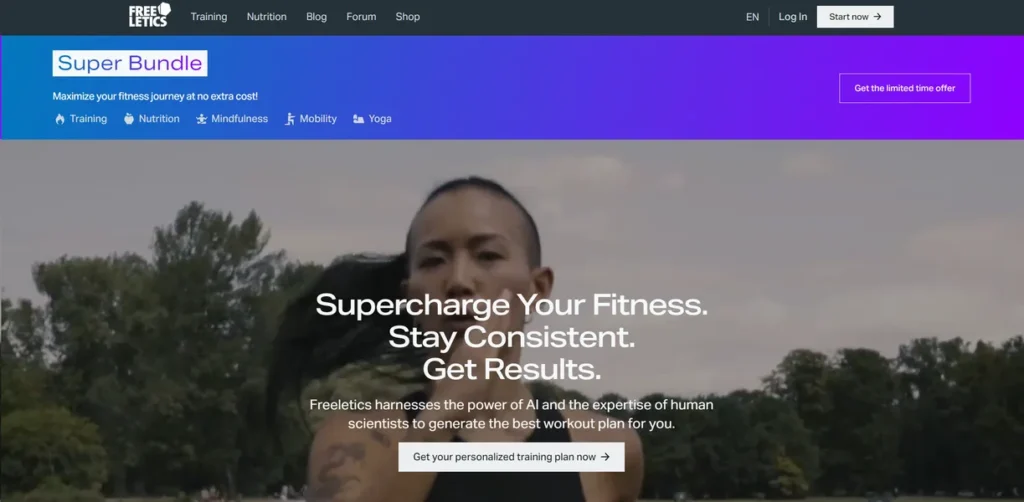
What is Freeletics?
Freeletics is a digital fitness application that provides AI-generated training plans. For the busy professional or small business owner, it functions as a virtual personal trainer, aiming to deliver efficient, customized workouts that can be performed without extensive gym equipment. The platform is designed to adapt to an individual’s fitness level, available time, and specific goals, such as strength gain or weight loss. It operates on the premise of high-intensity training (HIIT) and bodyweight exercises, positioning itself as a practical solution for maintaining physical health amidst a demanding schedule.
Key Features and How It Works
From a functional standpoint, Freeletics is built around a core AI engine that personalizes the user experience. The process begins with an initial fitness assessment to establish a baseline. Based on this data, the AI constructs a ‘Training Journey,’ which is a multi-week plan tailored to your objectives. As you complete workouts and provide feedback on their difficulty, the AI algorithm adjusts future sessions. This dynamic recalibration is the system’s primary mechanism for ensuring continued progress and avoiding plateaus.
- AI Coach: The core feature that designs and adapts your weekly training schedule based on your performance, feedback, and available time.
- Extensive Exercise Library: The app contains a large database of bodyweight and equipment-based exercises, each demonstrated with high-quality video loops to ensure proper form and reduce the risk of injury.
- Mindset Coaching: Beyond physical training, the platform includes audio-based coaching to help users build mental resilience and stay consistent, addressing the psychological component of fitness.
- Community Feed: An integrated social feature allows users to connect with others, share workout results, and offer encouragement. This can serve as a source of external motivation.
Pros and Cons
Evaluating Freeletics requires a pragmatic look at its operational advantages and limitations for a business-minded individual.
Pros
- Efficiency: The AI-driven personalization is designed to maximize results in a minimal amount of time by targeting your specific fitness level and progression rate.
- Flexibility: Workouts can be done at home, in an office, or while traveling, eliminating the time and cost associated with a gym membership.
- Data-Driven Progression: The adaptive algorithm provides a structured, scalable path for improvement, removing the guesswork from your fitness routine.
- Cost-Effectiveness: Compared to the recurring expense of a human personal trainer, the subscription fee is significantly lower.
Cons
- Requires Discipline: The model is entirely self-directed. Without the accountability of a scheduled appointment with a trainer, adherence depends solely on personal motivation.
- Internet Dependency: Core functionalities, including workout generation and progress tracking, require a stable internet connection.
- Limited Scope: While excellent for HIIT and general fitness, it may not suffice for users with highly specialized training goals, such as competitive powerlifting or sport-specific conditioning.
Who Should Consider Freeletics?
Freeletics is best suited for individuals who value structure and efficiency but require a high degree of flexibility. From an ROI perspective, it holds significant value for:
- Small Business Owners and Entrepreneurs: For those with unpredictable schedules, the ability to fit in an effective, guided workout at any time is a major operational advantage for maintaining personal health and energy levels.
- Busy Professionals: Individuals balancing demanding careers and personal lives can use Freeletics to outsource their workout planning and ensure their limited fitness time is spent effectively.
- Remote Teams: Companies can consider offering subscriptions as a wellness perk, providing a scalable and accessible health benefit for a distributed workforce.
- Self-Starters: Anyone with the internal drive to follow a plan without external oversight will find the tool’s structure and adaptive nature highly effective.
Pricing and Plans
Freeletics operates on a paid subscription model. While a free version exists with access to a limited selection of workouts, the core AI coaching functionality is behind a paywall.
- Pricing Model: Paid
- Starting Price: $34.99 per quarter for the Training Coach. Bundles including Nutrition and Mindset coaching are available at a higher price point.
- Available Plans: The primary offering is the AI-powered fitness coach, which can be purchased in various subscription lengths (e.g., quarterly, semi-annually, annually).
For the most current and detailed pricing information, it is recommended to consult the official Freeletics website.
What makes Freeletics great?
Tired of generic workout apps that fail to adapt to your actual progress and schedule? The primary differentiator for Freeletics is its intelligent adaptation. Unlike static workout plans or apps with pre-programmed difficulty levels, the AI ‘Coach’ actively learns from your input. If you report a workout was too easy, the next one will be harder. If you’re short on time, it can generate a shorter, high-intensity session. This continuous feedback loop creates a truly personalized training regimen that evolves with you, ensuring that the time and money you invest in the platform yield tangible, progressive results rather than stagnation.
Frequently Asked Questions
- Do I need any gym equipment to use Freeletics?
- No, the majority of the training journeys are centered around bodyweight exercises that can be performed anywhere. However, the app does offer training plans that incorporate basic equipment like pull-up bars, dumbbells, and kettlebells if you have access to them.
- How much time do I need to commit per day?
- The time commitment is flexible. The AI Coach can generate sessions ranging from 15 to 45 minutes, depending on your availability and the specifics of your training plan. You can inform the app of your time constraints for any given week.
- Can Freeletics replace a personal trainer?
- For many users, yes. It provides the core benefits of a trainer—personalized planning, progression, and exercise guidance—at a fraction of the cost. However, it cannot offer the in-person form correction or the specific motivational dynamic of a human trainer.
- Is the subscription cost worth it for a busy professional?
- The value proposition lies in its efficiency. If the app enables you to consistently maintain your fitness, leading to increased energy, focus, and productivity, the subscription can be viewed as a worthwhile investment in your personal and professional performance.