

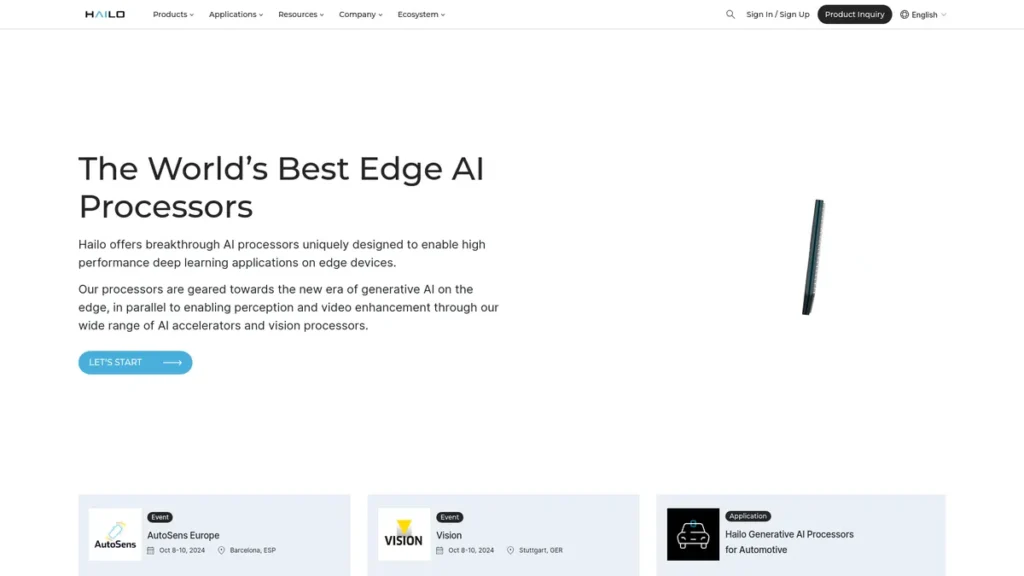
What is Hailo?
Hailo is a technology company that develops specialized microprocessors and software designed to run artificial intelligence applications directly on devices, rather than in the cloud. In business terms, this means bringing high-powered AI capabilities—like real-time video analysis or complex decision-making—to your operational hardware. Instead of sending vast amounts of data to a remote server for processing, which costs money and introduces delays, Hailo’s technology allows devices like security cameras, factory robots, or in-store kiosks to think for themselves. This approach, known as edge AI, is built for environments where speed, data privacy, and operational reliability are non-negotiable. While it requires an investment in specific hardware, the goal is to create smarter, more efficient, and more responsive systems at the point where data is generated.
Key Features and How It Works
Hailo’s ecosystem is a combination of hardware and software designed to make edge AI deployment feasible for various industries. For a small business owner, understanding these components is key to seeing the potential return on investment.
- Edge AI Processors: These are the core of Hailo’s offering. The processors are engineered to run complex neural networks with high efficiency and low power consumption. Think of it like having a highly competent branch manager on-site who is empowered to make immediate decisions, rather than having to call corporate headquarters (the cloud) for every customer query. This local authority eliminates delays and ensures operations continue even if the internet connection is unstable.
- Generative AI Accelerators: With modules like the Hailo-10H, the company is bringing generative AI to edge devices. This allows applications like sophisticated chatbots, real-time language translation, or content summarization to run locally, ensuring private customer data never leaves the premises.
- AI Vision Processors: The Hailo-15 processor is specifically designed for high-end video analytics. It can handle multiple camera streams and perform complex computer vision tasks, such as identifying anomalies in a manufacturing line or tracking customer flow in a retail store, all in real-time.
- Comprehensive Software Suite: Hardware is only half the battle. Hailo provides a robust suite of software tools, including a compiler and runtime environment, to help developers deploy their AI models onto Hailo processors. This ecosystem is intended to streamline the transition from development to a functional, real-world application.
Pros and Cons
Evaluating Hailo requires a pragmatic look at its potential benefits versus its inherent challenges, especially from a business owner’s perspective.
Pros
- Reduced Latency: By processing data on the device, decisions are nearly instantaneous. This is critical for applications like industrial quality control or autonomous vehicle safety systems.
- Lower Operational Costs: While the upfront cost is a factor, processing data locally can significantly reduce or eliminate the ongoing expenses associated with cloud computing and data transmission.
- Enhanced Data Privacy: Sensitive information, such as customer video feeds or proprietary manufacturing data, remains on-site, drastically reducing the risk of data breaches during transmission.
- Improved Reliability: Edge devices with Hailo processors can function independently of an internet connection, making them ideal for remote locations or mission-critical systems that cannot afford downtime.
Cons
- Significant Upfront Investment: This isn’t just software you can download. Implementing Hailo requires purchasing and integrating specialized hardware, which can be a considerable capital expense.
- Steep Learning Curve: Leveraging this technology effectively may require specialized expertise in both hardware integration and AI model deployment. It’s not a plug-and-play solution for the average user.
- Hardware Dependency: Your application is tied to Hailo’s specific hardware ecosystem, which may limit flexibility if you decide to pivot your technology stack in the future.
Who Should Consider Hailo?
Hailo is not a one-size-fits-all solution. It is best suited for businesses and enterprises where the benefits of real-time, on-device processing provide a clear competitive advantage or solve a critical operational bottleneck. Consider Hailo if your business:
- Relies on real-time video analytics: This includes smart cities managing traffic, retail stores optimizing layouts, or industrial sites monitoring for safety and quality control.
- Requires high levels of data security and privacy: Healthcare applications analyzing patient imagery or any business handling sensitive customer data can benefit from keeping processing local.
- Operates in environments with unreliable internet: Agriculture, remote industrial monitoring, and logistics operations where connectivity is spotty are prime use cases.
- Needs to reduce cloud computing costs: For businesses running AI models 24/7, the cumulative cost of cloud processing can be enormous. Hailo presents an alternative with a fixed upfront cost and lower operational spend.
Conversely, businesses whose AI needs are not time-sensitive or that handle non-sensitive data may find traditional cloud-based solutions more cost-effective and easier to implement.
Pricing and Plans
Specific pricing information for Hailo’s processors and solutions is not publicly available. Costs are typically dependent on the volume of hardware purchased, the specific modules required, and the level of enterprise support and software integration needed. As this is a B2B solution for specialized hardware, pricing is determined through direct consultation and tailored to the scale of the deployment. For the most accurate and up-to-date pricing, please visit the official Hailo website.
What makes Hailo great?
Tired of paying for cloud processing fees and dealing with the lag of sending data back and forth? Hailo’s greatness lies in its focused, uncompromising commitment to edge processing. By building its hardware and software from the ground up for this purpose, it provides a powerful solution to the core weaknesses of cloud-based AI: latency, privacy, and connectivity dependence. For a business, this translates into tangible benefits. It means a security camera that doesn’t just record a break-in but alerts authorities the instant it happens. It means a factory machine that identifies a defect and stops the production line before thousands of faulty units are made. This shift from reactive to proactive capability, enabled by local, real-time AI, is what sets Hailo apart and makes the hardware investment a compelling proposition for the right applications.
Frequently Asked Questions
- Do I need a team of AI experts to use Hailo?
- While Hailo provides a software suite to simplify deployment, integrating the hardware and optimizing AI models for it typically requires technical expertise. Businesses without an in-house engineering team may need to work with an integration partner or consultant to get started.
- Can Hailo work with my existing camera or sensor systems?
- Hailo’s processors are designed to be integrated into broader systems. They can process data feeds from various cameras and sensors, but this requires hardware integration. You would typically purchase a device with Hailo’s chip already inside or work with a hardware partner to build a custom solution.
- What’s the real difference between edge AI and cloud AI for my business?
- The main difference is location. Cloud AI sends your data to a remote server for analysis, which is flexible but can be slow and costly. Edge AI, using technology like Hailo’s, performs the analysis directly on your device. This is much faster, more private, and works without an internet connection, but requires specialized hardware on-site.
- Is Hailo just hardware, or does it include software?
- Hailo provides a complete ecosystem. The core product is the AI accelerator hardware (the processor), but it is supported by a comprehensive software suite that includes tools for developers to compile, optimize, and deploy their AI models onto the hardware efficiently.