

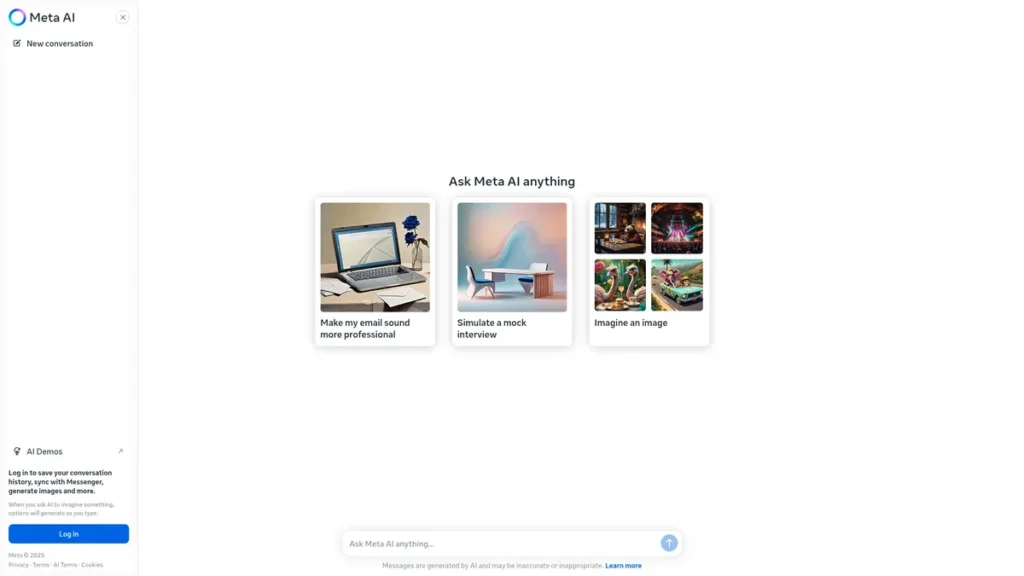
What is Meta AI?
Meta AI is not a single product but a broad initiative from the parent company of Facebook and Instagram. For a business owner, it’s best understood as two distinct things. First, it’s a suite of user-facing AI assistants and creative tools being integrated directly into apps like WhatsApp, Messenger, and Instagram. Think of these as Meta’s answer to ChatGPT, designed for everyday tasks like generating images or answering questions. Second, and more importantly for businesses seeking a competitive edge, Meta AI is a research powerhouse that releases powerful, open-source foundational models, most notably the Llama series. These models are the engines that can be customized to power unique applications, from bespoke customer service chatbots to sophisticated data analysis tools, offering a level of control proprietary systems can’t match.
Key Features and How It Works
From a business perspective, the value of Meta AI isn’t in its academic publications but in its deployable technology. The core features translate directly to operational capabilities, provided you have the technical resources to implement them.
- Open-Source Foundational Models (Llama series): This is Meta AI’s crown jewel for businesses. These large language models (LLMs) are trained on vast datasets and then released for public use. Think of a foundational model like a brilliant, highly-educated intern. They have a massive base of general knowledge but require specific direction and training (a process called ‘fine-tuning’) on your company’s data to become a true expert in your specific business operations. This allows you to build proprietary AI solutions without starting from scratch.
- Integrated Generative AI Tools: Across Meta’s social media platforms, you’ll find AI tools for generating text and images. For a marketing team, this means creating ad copy variations or social media visuals directly within the platforms they already use, potentially speeding up content creation workflows.
- Advanced Computer Vision: Meta’s research in computer vision powers features like image recognition and analysis. A practical application for a retail business could be using this technology to analyze user-generated content on Instagram, identifying products and tracking visual trends without manual oversight.
Pros and Cons
Evaluating Meta AI requires a pragmatic look at the trade-offs between power and accessibility.
Pros:
- Unprecedented Access: The release of powerful models like Llama 3 on an open-source basis gives businesses access to state-of-the-art technology without licensing fees, a significant cost advantage over competitors like OpenAI’s GPT-4.
- High Degree of Customization: Unlike closed-box APIs, open-source models can be fine-tuned and modified extensively, allowing you to create a truly unique AI that aligns perfectly with your brand voice and operational needs.
- Ecosystem Integration: The AI tools built into Facebook, Instagram, and WhatsApp offer a frictionless way for marketing and customer service teams to leverage AI within existing workflows.
Cons:
- Significant Technical Overhead: Using open-source models is not a plug-and-play solution. It requires substantial computational resources (i.e., server costs) and developer expertise to deploy, maintain, and secure. The ‘free’ model can quickly become expensive.
- Steep Learning Curve: Without an in-house AI or machine learning specialist, customizing and deploying these models is a formidable challenge for the average small business.
- Data Privacy Concerns: Leveraging AI within the Meta ecosystem inevitably raises questions about data privacy and how your business’s or customers’ information is being used by the platform.
Who Should Consider Meta AI?
Meta AI is not a one-size-fits-all solution. Its suitability depends heavily on a company’s technical capabilities and strategic goals.
- Tech Startups and Development Teams: Companies looking to build a unique AI-powered feature or product will find the open-source models invaluable. They provide a powerful, cost-effective foundation to innovate upon.
- Businesses with In-House Technical Talent: Companies with developers or data scientists on staff can leverage Meta’s models to create custom internal tools for data analysis, process automation, or enhanced customer support.
- Marketing Agencies and Social Media Managers: The integrated generative AI tools are a low-barrier entry point for creative teams wanting to experiment with AI-driven content creation directly within their primary advertising platforms.
- Businesses Without Technical Resources: These companies should be cautious. Directly using Meta’s open-source models is likely impractical. It would be wiser to use products and services from other companies that build on top of Meta’s technology.
Pricing and Plans
Pricing information for specific enterprise solutions or advanced API access was not readily available at the time of this review. Many of Meta AI’s foundational models and tools are released on an open-source basis, meaning they are free to use but require your own computational resources and infrastructure, which incurs its own costs. For the most accurate and up-to-date pricing, please visit the official Meta AI website.
What makes Meta AI great?
Tired of paying steep subscription fees for AI tools that offer limited customization and control? Meta AI’s greatest strength lies in its strategic commitment to open-source development. By making its powerful Llama models freely available for commercial use, Meta has democratized access to cutting-edge AI. This allows businesses to escape the ‘one-size-fits-all’ trap of many SaaS AI products. Instead of just renting access to a generic AI, you can build and own a custom-trained asset. This fosters deeper integration, creates a more defensible competitive advantage, and ultimately gives you greater control over your costs and your data—a compelling proposition for any business owner focused on long-term, tangible value.
Frequently Asked Questions
Do I need to be a developer to use Meta AI?
It depends. To use the consumer-facing AI assistant in Instagram or WhatsApp, no technical skill is needed. However, to leverage the powerful open-source models like Llama for your business, you will need significant development and machine learning expertise to deploy, fine-tune, and manage the model.
How is Meta AI different from ChatGPT or Google Gemini?
The primary difference is the open-source model. While ChatGPT and Gemini are primarily products you access via an API or web interface, Meta AI (specifically, Llama) provides the underlying model itself. This allows for deeper customization and self-hosting, giving you more control, whereas ChatGPT and Gemini are closed, proprietary systems.
Can I use Meta’s Llama models for commercial purposes?
Yes, the latest versions of the Llama models are available for commercial use, subject to Meta’s acceptable use policy. This is a major advantage for businesses looking to build products or services on top of a powerful foundational model without prohibitive licensing fees.
What are the ‘real’ costs of using ‘free’ open-source models?
While the model itself is free to download, you are responsible for the costs of running it. This includes server and GPU costs (which can be substantial for high-traffic applications), as well as the salary for the technical talent required to implement and maintain the system.