

What is MindsDB?
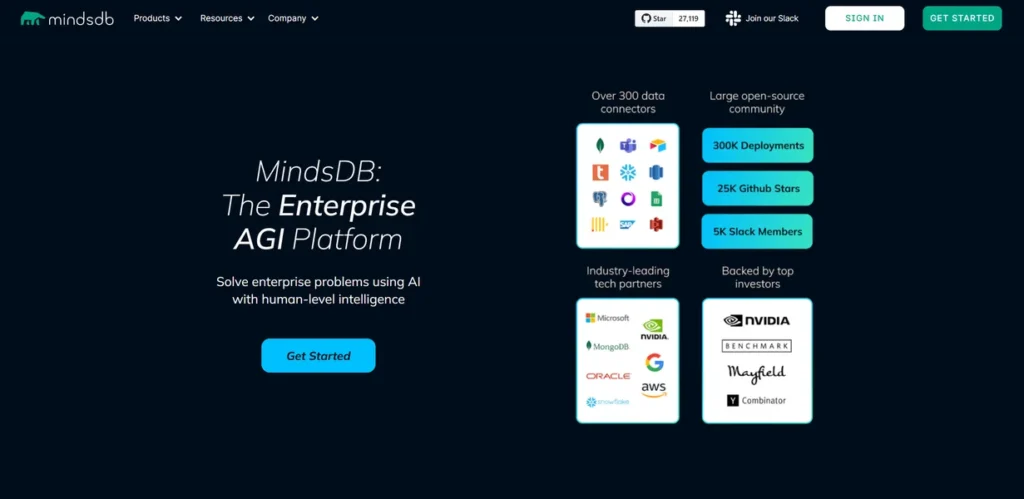
MindsDB is an open-source platform that functions as an AI layer on top of existing databases, effectively bringing machine learning capabilities directly to the data source. For developers and data engineers, this means you can perform complex predictive analytics using standard SQL commands, eliminating the need to build and maintain separate, complex data pipelines for ML model inference. It acts as a federated query engine, creating a seamless interface between your application, your data, and various machine learning models. By treating ML models as virtual tables, MindsDB fundamentally simplifies the architecture required to build and deploy enterprise-grade AI applications, allowing for real-time predictions without moving large datasets.
Key Features and How It Works
MindsDB’s architecture is built around a few core technical concepts that enable its powerful functionality. Its primary components work in concert to deliver a streamlined ML workflow.
- Federated Data Connectors: At its core, MindsDB uses a system of data handlers to connect to a wide array of sources, including SQL databases (like PostgreSQL, MySQL), data warehouses (like Snowflake, BigQuery), and even non-database sources like SaaS application APIs. This allows developers to query disparate systems through a single, unified SQL interface.
- AI Engines and ML Handlers: The platform integrates with various ML frameworks and models, including popular libraries like Hugging Face, OpenAI, and Scikit-learn. Developers can use pre-trained models or train new ones using a simple `CREATE PREDICTOR` SQL statement. This statement automates the processes of data preparation, model training, and validation.
- SQL-Based Model Querying: Once a model (or ‘predictor’) is created, it can be queried like a standard database table. A `SELECT` statement joining a data table with a model table triggers real-time predictions. This abstraction is the key to its ease of use, as any application with a standard database driver can leverage machine learning without requiring a dedicated ML client library.
- Scalable and Open-Source: Built with enterprise scale in mind, MindsDB’s federated architecture avoids data centralization bottlenecks. As an open-source project, it offers significant flexibility, allowing development teams to inspect the codebase, contribute features, and create custom handlers for proprietary data sources or specialized ML models.
Pros and Cons
From a software development perspective, MindsDB presents a compelling but nuanced value proposition.
Pros:
- Reduced Architectural Complexity: By embedding ML logic within the data layer, it dramatically simplifies application stacks. Developers can avoid building microservices or separate APIs just for model inference.
- Improved Developer Velocity: Leveraging existing SQL skills allows data analysts and backend developers to build AI-powered features quickly, democratizing ML development within an organization.
- Enhanced Data Security: Since data is not moved out of the database for prediction, the attack surface is reduced, simplifying security compliance and governance.
- High Extensibility: The open-source nature and modular handler architecture allow for deep customization and integration with proprietary internal systems.
Cons:
- Potential for Performance Overhead: While efficient, running inference via a federated query layer can introduce latency compared to a highly optimized, dedicated ML inference server. Performance is heavily dependent on the complexity of the model and the underlying data source’s responsiveness.
- Steep Learning Curve for Advanced Use Cases: While basic predictions are straightforward, fine-tuning models, debugging, and optimizing complex queries require a solid understanding of both SQL and machine learning principles.
- Integration Maturity Varies: The quality and feature-completeness of data and ML handlers can vary. Some integrations may lack support for advanced database features or require custom development for full functionality.
Who Should Consider MindsDB?
MindsDB is an excellent fit for specific technical teams and roles seeking to streamline their MLOps and application development processes.
- Software Developers and Data Engineers: Teams looking to integrate AI features into applications without building a separate ML infrastructure will find MindsDB’s approach highly efficient. It’s ideal for adding forecasting, classification, or anomaly detection directly into existing systems.
- Data Analysts with SQL Expertise: Professionals who are proficient in SQL but not in Python or R can use MindsDB to independently build and test predictive models, reducing their reliance on dedicated data science teams.
- Startups and Lean Tech Teams: Organizations aiming to quickly prototype and deploy AI-driven products can leverage the platform’s open-source nature and rapid development cycle to gain a competitive edge.
- Enterprises with Distributed Data: Companies with data spread across multiple databases, data warehouses, and SaaS platforms can use MindsDB as a unified layer to generate insights without undertaking costly and complex data consolidation projects.
Pricing and Plans
Detailed pricing information for MindsDB’s enterprise solutions was not available. The platform offers a powerful, open-source version that is free to download and use, which is suitable for many use cases and for teams looking to evaluate the technology. For enterprise-grade features, support, and managed cloud offerings, direct consultation with the MindsDB sales team is required. For the most accurate and up-to-date pricing, please visit the official MindsDB website.
What makes MindsDB great?
Tired of the engineering overhead required to bridge the gap between your production database and your machine learning models? MindsDB’s greatest strength lies in its elegant architectural solution to this common problem. By treating ML models as virtual database tables, it provides a powerful abstraction layer that fundamentally changes how developers interact with AI. This in-database approach eliminates entire categories of technical debt associated with traditional MLOps, such as data pipeline maintenance, API versioning for models, and data synchronization issues. It allows for a clean separation of concerns where the application logic remains focused on business rules, while predictive logic is managed directly within the data query layer. This leads to cleaner code, faster deployment cycles, and a more scalable and maintainable system architecture.
Frequently Asked Questions
- How does MindsDB handle real-time predictions?
- MindsDB processes predictions at query time. When you execute a `SELECT` statement that joins a data table with a MindsDB predictor, the engine fetches the necessary data, passes it to the specified ML model for inference, and returns the prediction as part of the query result set. This makes it suitable for real-time application use cases where predictions are needed on demand.
- Can I integrate my own custom-trained machine learning models with MindsDB?
- Yes. MindsDB is designed for extensibility. You can create a custom ML handler to integrate models from virtually any framework. The platform also has built-in integrations for bringing in models from popular hubs like Hugging Face and platforms like OpenAI, allowing you to leverage both custom-trained and third-party models.
- What is the performance impact of running MindsDB on my production database?
- MindsDB acts as a proxy, translating SQL queries into the necessary operations for data retrieval and model inference. The performance impact depends on the query complexity, model size, and the latency of the underlying database. For read-heavy operations, the impact is often minimal. MindsDB does not run the training process inside your production database; it orchestrates it externally, minimizing the performance load during the resource-intensive training phase.