

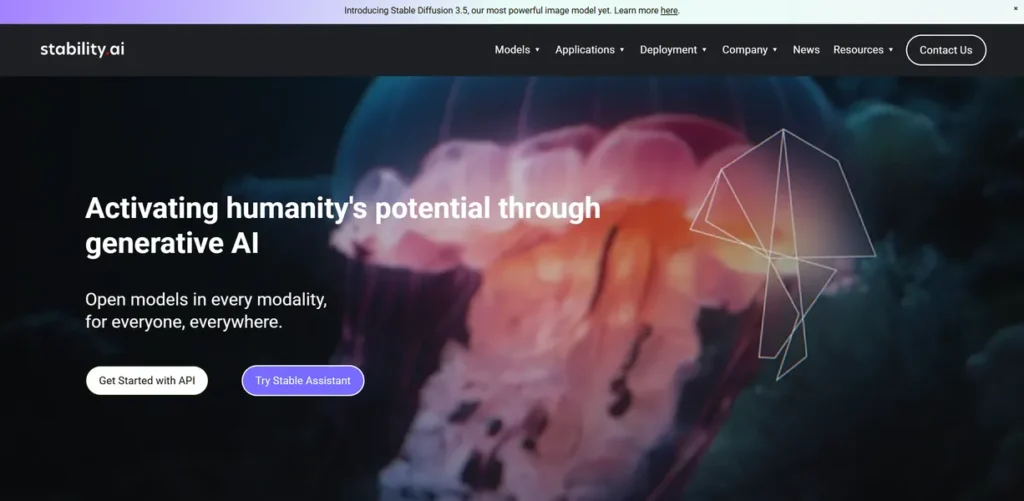
What is Stability?
From a developer’s standpoint, Stability.ai represents a foundational shift in the generative AI landscape. It’s not merely a service provider but a core contributor, championing an open-access philosophy that puts state-of-the-art models directly into the hands of builders. The organization is the driving force behind renowned models like Stable Diffusion, offering a powerful, multi-modal suite for generating images, video, audio, and language. For developers and technical teams, Stability provides the fundamental building blocks—accessible via APIs or for self-hosting—to construct sophisticated, AI-driven applications. This approach moves beyond the typical ‘black box’ API, empowering users with unprecedented control and flexibility to innovate on their own terms and infrastructure.
Key Features and How It Works
Stability’s ecosystem is built upon a collection of powerful, specialized models that can be orchestrated to create complex generative workflows. Integration is typically handled through well-documented APIs or by deploying the open models on private infrastructure for maximum control.
- Stable Diffusion 3.5: This is the flagship text-to-image model. For developers, its true power lies in its variants and customizability. You can leverage the API for quick integrations or download the model weights to fine-tune it on proprietary datasets, creating highly specialized image generation capabilities that align perfectly with a specific application’s domain.
- Stable Video Diffusion: This model extends generative capabilities into the time dimension. Think of it as a sophisticated flip-book artist; you provide a starting image (the first page), and the model intelligently generates the subsequent frames (pages) to create a fluid, coherent animation. For a developer, this means you’re not just calling a generic text-to-video API; you’re providing an initial visual state and letting the model extrapolate motion and narrative, offering a powerful tool for dynamic content creation.
- Stable Audio 2.0: Leveraging audio diffusion technology, this model allows for the programmatic generation of music and sound effects from text prompts. This opens up scalable solutions for everything from dynamic in-game soundscapes to custom audio tracks for digital advertising, all accessible through a straightforward API.
- Stable LM 2 1.6B: This is a lightweight yet powerful language model designed for high performance on common hardware. Its open-access nature makes it an excellent foundation for building custom chatbots, content summarizers, and other language-processing features without the high computational and financial costs associated with larger, proprietary models.
Pros and Cons
From a technical implementation perspective, Stability presents a compelling but nuanced value proposition.
Pros:
- Unmatched Flexibility: The ability to self-host and fine-tune models on your own infrastructure is a critical advantage for applications requiring data privacy, low latency, or highly specialized outputs.
- Open-Access Philosophy: Permissive licensing for many models eliminates vendor lock-in and significantly lowers the barrier to entry for building commercial-grade AI products.
- Robust Multi-Modal Ecosystem: Having high-quality models for image, video, audio, and language from a single source simplifies the development of complex, cross-functional AI applications.
- Strong Community and Extensibility: The open nature of the models has fostered a vibrant developer community, leading to a wealth of third-party tools, extensions, and shared knowledge that accelerate development.
Cons:
- Significant Infrastructure Overhead: Running these models in a production environment, especially the larger variants, demands substantial GPU resources and DevOps expertise in ML operations (MLOps).
- Steep Learning Curve for Customization: While the APIs are accessible, unlocking the full potential through fine-tuning requires a deep understanding of machine learning principles and data preparation.
- Community-Reliant Support Model: For mission-critical enterprise applications, relying primarily on community forums and documentation for support can introduce business risk compared to the dedicated support channels of proprietary services.
Who Should Consider Stability?
Stability is an ideal choice for technical teams and organizations that prioritize control, customization, and cost-efficiency over a fully managed, turnkey solution.
- Startups and Indie Developers: Teams looking to build innovative AI features without incurring the high costs of API-based services can leverage Stability’s open models to create a competitive advantage.
- In-House AI/ML Teams: Corporate data science and engineering teams can use Stability’s foundational models as a robust baseline for building proprietary, fine-tuned solutions that address specific business needs.
- Creative Technology Platforms: Companies building SaaS tools for marketing, media, or design can integrate Stability’s models to offer powerful generative content features directly within their products.
- Academic and Research Institutions: The open and inspectable nature of the models makes them an invaluable resource for pushing the boundaries of AI research and development.
Pricing and Plans
Stability.ai operates on a dual-licensing model. Many of its core models are available for free under a permissive community license, allowing for broad use in both research and commercial applications. For enterprises seeking advanced features, dedicated support, or the right to deploy on a larger scale, Stability offers paid, self-hosted licenses. At the time of this review, specific pricing tiers were not publicly listed. For the most accurate and up-to-date pricing, please visit the official Stability website.
What makes Stability great?
Struggling with the limitations and high costs of closed-source AI models that stifle true innovation? Stability’s core strength lies in its definitive answer to this problem: its unwavering commitment to open access. This is not just a feature; it is a fundamental design philosophy that sets it apart from API-only providers. Greatness for a developer isn’t just about what a tool can do, but how much control you have over it. Stability provides the raw, powerful engine, not just a polished dashboard. This allows for deep integration, custom optimization, and the freedom to build without being tethered to a specific vendor’s roadmap or pricing structure. It democratizes access to cutting-edge AI, fostering an ecosystem where innovation is driven by the community, not just a handful of large corporations.
Frequently Asked Questions
- Can I use Stability’s models in my commercial software?
- Yes, many models are available under a community license that permits commercial use. However, it’s crucial to review the specific license for each model and consider a professional license for enterprise-level deployment to ensure compliance.
- What kind of hardware is required to self-host Stability models?
- Self-hosting is resource-intensive. While smaller models like Stable LM 2 1.6B can run on consumer-grade hardware, production-level image and video models typically require enterprise-grade GPUs (e.g., NVIDIA A100/H100) and significant VRAM to operate efficiently.
- How does Stability compare to API-only services like Midjourney or DALL-E 3?
- The primary differentiator is control and access. API-only services offer a simplified, managed experience but with limited customizability. Stability provides the underlying models, offering developers unparalleled control to fine-tune, optimize, and self-host for specific needs, data privacy, and potentially lower long-term costs.
- Is API access available if I don’t want to self-host?
- Yes, Stability offers a Developer Platform with APIs that allow you to leverage their models without managing the underlying infrastructure, providing a balance between ease of use and access to powerful, open technology.